傺 (chì) means "to stop; to wait; disappointed" in Chinese. It has 13 strokes with the radical 亻.
Rated 3.9/5 in difficulty (challenging).
Appears in 3+ common words including 侘傺 (chà chì), 傺立 (chì lì), 傺然 (chì rán).
Due to its 13 strokes, Hanzi Writer's error detection shows 傺 requires focused practice — most learners need 10+ attempts for consistent accuracy.
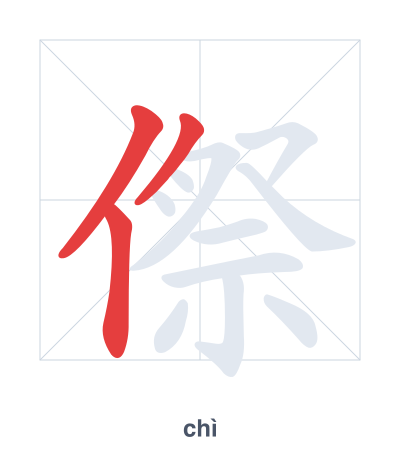
Open Hanzi Writer to see the animated stroke order and practice writing 傺 with real-time feedback.
The character 傺 (chì) is written with 13 strokes. Follow the standard Chinese stroke order: top to bottom, left to right, outside before inside. The radical 亻 is one of its key components.
Practice the correct stroke order with the Hanzi Writer app to see animated stroke-by-stroke guidance with real-time feedback.
傺 means to stop; to wait; disappointed.
The character 傺 combines 亻 (person) with 祭 (sacrifice). A person at a sacrificial ritual often pauses, waits, or feels disappointment if the ceremony doesn't proceed as expected, forming the meanings 'to stop', 'to wait', and 'disappointed'.
💡 Memory Tip: Imagine a person (亻) at a sacrifice (祭) who stops and waits, but then looks disappointed when the offering doesn't appear.
他心情不好,很侘傺。
tā xīn qíng bù hǎo hěn chà chì
He was in a bad mood and felt dejected.
他在路边傺立良久。
tā zài lù biān chì lì liáng jiǔ
He stood by the roadside for a long time.
他傺然若失。
tā chì rán ruò shī
He looked disappointed and lost.
Open Hanzi Writer to see the animated stroke order and practice writing 傺 with real-time feedback.
✨ Animated stroke order · Handwriting recognition · HSK-graded practice · Free to use
The character 傺 is formed by the person radical 亻 on the left and the phonetic component 祭 (jì, meaning sacrifice) on the right. This structure suggests a person in a state of solemn waiting or disappointment, similar to the mood during a ritual. The combination conveys the sense of stopping or feeling despondent.