傻 (shǎ) means "foolish; silly; stupid" in Chinese. It has 13 strokes with the radical 亻, and is HSK Level 5.
Rated 3.9/5 in difficulty (challenging).
Harder than 44% of HSK Level 5 characters.
Appears in 3+ common words including 傻瓜 (shǎ guā), 傻笑 (shǎ xiào), 吓傻 (xià shǎ).
Due to its 13 strokes, Hanzi Writer's error detection shows 傻 requires focused practice — most learners need 10+ attempts for consistent accuracy.
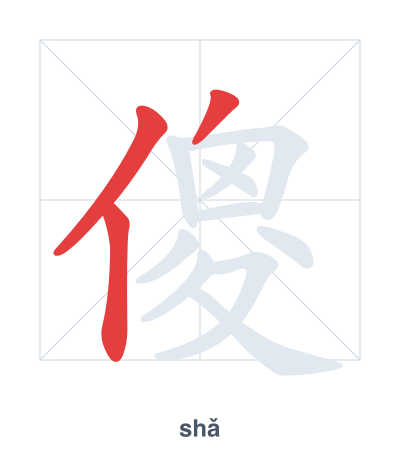
Open Hanzi Writer to see the animated stroke order and practice writing 傻 with real-time feedback.
The character 傻 (shǎ) is written with 13 strokes. Follow the standard Chinese stroke order: top to bottom, left to right, outside before inside. The radical 亻 is one of its key components.
Practice the correct stroke order with the Hanzi Writer app to see animated stroke-by-stroke guidance with real-time feedback.
傻 means foolish; silly; stupid.
As an HSK Level 5 character, 傻 is an intermediate-level character.
The character 傻 (shǎ) combines the person radical 亻 with a right component made of 夂 (foot, implying movement), 囗 (enclosure), and 女 (woman). This visual suggests a person acting slowly or foolishly within a confined space, evoking the idea of a simpleton or someone naive.
💡 Memory Tip: Picture a silly person (亻) who is so clueless that he walks (夂) into a box (囗) and asks a woman (女) for directions, getting stuck there.
你真是个傻瓜。
nǐ zhēn shì gè shǎ guā
You are such a fool.
他对着手机傻笑。
tā duì zhuó shǒu jī shǎ xiào
He smirked at his phone.
那个孩子被吓傻了。
nà ge hái zi bèi xià shǎ le
That child was scared stiff.
Open Hanzi Writer to see the animated stroke order and practice writing 傻 with real-time feedback.
✨ Animated stroke order · Handwriting recognition · HSK-graded practice · Free to use
The character 傻 is composed of the radical 亻 (person) on the left and the phonetic component 夋 (jùn) on the right. The radical suggests that the character relates to a person's behavior or state, while the right part hints at the pronunciation. Together, they form a character describing a person acting foolishly or stupidly.