儿 (ér) means "Child; son" in Chinese. It has 2 strokes with the radical 儿, and is HSK Level 1.
Rated 1.4/5 in difficulty (beginner-friendly).
Harder than 3% of HSK Level 1 characters.
Appears in 3+ common words including 儿子 (ér zi), 女儿 (nǚ ér), 花儿 (huā ér).
In the Hanzi Writer app, most learners master 儿 within 3 practice attempts using stroke-by-stroke animation.
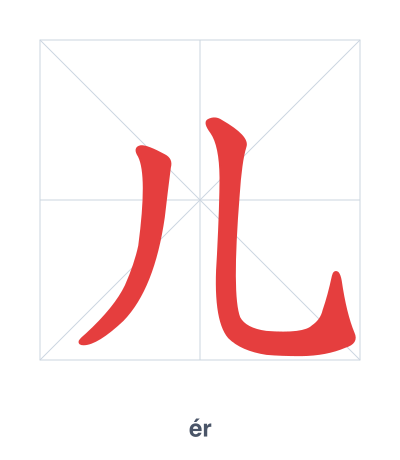
Open Hanzi Writer to see the animated stroke order and practice writing 儿 with real-time feedback.
The character 儿 (ér) is written with 2 strokes. Follow the standard Chinese stroke order: top to bottom, left to right, outside before inside. The radical 儿 is one of its key components.
Practice the correct stroke order with the Hanzi Writer app to see animated stroke-by-stroke guidance with real-time feedback.
儿 means Child; son.
As an HSK Level 1 character, 儿 is among the first characters beginners learn.
The character 儿 is a pictograph depicting a child with a large head and arms, based on the ancient form showing a person with an incomplete or smaller body, emphasizing youth. Over time, it simplified into two strokes representing the legs.
💡 Memory Tip: Imagine the two strokes as the tiny legs of a toddling child taking its first steps.
我有一个儿子。
wǒ yǒu yí gè ér zi
I have a son.
她女儿很漂亮。
tā nǚ ér hěn piào liàng
Her daughter is very beautiful.
这里的花儿开了。
zhè lǐ de huā ér kāi le
The flowers here have bloomed.
Open Hanzi Writer to see the animated stroke order and practice writing 儿 with real-time feedback.
✨ Animated stroke order · Handwriting recognition · HSK-graded practice · Free to use
儿 is a simple pictograph that originally depicted a child with legs apart, symbolizing a young person. As a radical, it appears in characters related to children or human figures, like 兄 (older brother) and 先 (first).