息 (xī) means "To rest or breathe." in Chinese. It has 10 strokes with the radical 心, and is HSK Level 1.
Rated 3.7/5 in difficulty (challenging).
Harder than 86% of HSK Level 1 characters.
Appears in 3+ common words including 休息 (xiū xī), 消息 (xiāo xī), 利息 (lì xī).
Due to its 10 strokes, Hanzi Writer's error detection shows 息 requires focused practice — most learners need 10+ attempts for consistent accuracy.
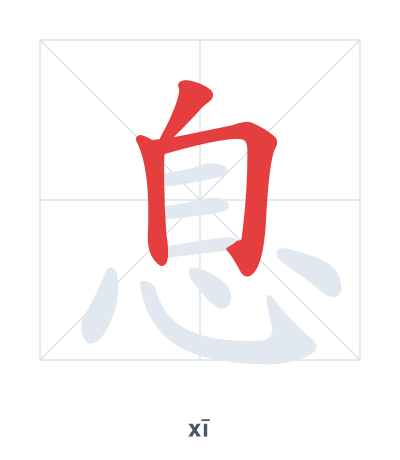
Open Hanzi Writer to see the animated stroke order and practice writing 息 with real-time feedback.
The character 息 (xī) is written with 10 strokes. Follow the standard Chinese stroke order: top to bottom, left to right, outside before inside. The radical 心 is one of its key components.
Practice the correct stroke order with the Hanzi Writer app to see animated stroke-by-stroke guidance with real-time feedback.
息 means To rest or breathe..
As an HSK Level 1 character, 息 is among the first characters beginners learn.
息 combines 自 (nose) above 心 (heart), indicating breath traveling from the nose to the heart. In ancient Chinese thought, breathing connects the nose and heart, and resting is when the breath calms and the heart is at peace.
💡 Memory Tip: Imagine your nose (自) on top of your heart (心) — when you breathe deeply, the heart rests; picture a 'sigh' (息) of relief as breath settles into your heart.
累了就去休息吧。
lèi le jiù qù xiū xī ba
If you're tired, go take a rest.
这是一个好消息。
zhè shì yí gè hǎo xiāo xī
This is good news.
银行的利息很高。
yín háng de lì xī hěn gāo
The bank's interest rate is high.
Open Hanzi Writer to see the animated stroke order and practice writing 息 with real-time feedback.
✨ Animated stroke order · Handwriting recognition · HSK-graded practice · Free to use
息 combines 自 (nose) on top and 心 (heart) below. In ancient Chinese, breathing was seen as air flowing from the nose to the heart, so the structure represents the idea of breath and rest.