像 (xiàng) means "to resemble; like; image; statue" in Chinese. It has 13 strokes with the radical 亻, and is HSK Level 2.
Rated 3.4/5 in difficulty (challenging).
Harder than 57% of HSK Level 2 characters.
Appears in 3+ common words including 好像 (hǎo xiàng), 像章 (xiàng zhāng), 录像 (lù xiàng).
Due to its 13 strokes, Hanzi Writer's error detection shows 像 requires focused practice — most learners need 10+ attempts for consistent accuracy.
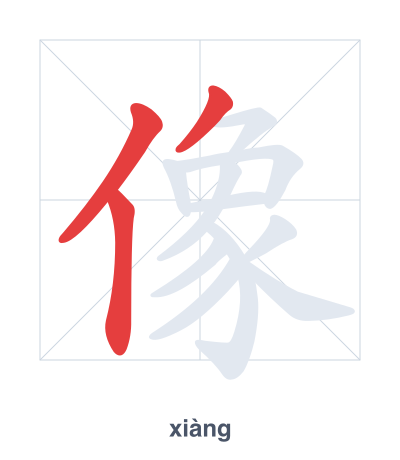
Open Hanzi Writer to see the animated stroke order and practice writing 像 with real-time feedback.
The character 像 (xiàng) is written with 13 strokes. Follow the standard Chinese stroke order: top to bottom, left to right, outside before inside. The radical 亻 is one of its key components.
Practice the correct stroke order with the Hanzi Writer app to see animated stroke-by-stroke guidance with real-time feedback.
像 means to resemble; like; image; statue.
As an HSK Level 2 character, 像 is among the first characters beginners learn.
像 combines the person radical 亻 with 象 (elephant), which was a phonetic component but also contributed the meaning of 'image' or 'form' in ancient Chinese. Originally it referred to a likeness or statue of a person, later expanding to mean 'to resemble' or 'appearance'.
💡 Memory Tip: Imagine a person (亻) posing beside an elephant (象) statue that looks exactly like them—a perfect resemblance.
他好像生病了。
tā hǎo xiàng shēng bìng le
He seems to be sick.
他胸前戴着一枚像章。
tā xiōng qián dài zhe yī méi xiàng zhāng
He is wearing a badge on his chest.
我们正在看录像。
wǒ men zhèng zài kàn lù xiàng
We are watching a video.
Open Hanzi Writer to see the animated stroke order and practice writing 像 with real-time feedback.
✨ Animated stroke order · Handwriting recognition · HSK-graded practice · Free to use
像 consists of the radical 亻 (person) on the left and 象 (elephant or shape/appearance) on the right. Together, they suggest "a person's appearance" or "to resemble something" — the person radical points to people, while 象 gives the idea of form or likeness.