咸 (xián) means "salty" in Chinese. It has 9 strokes with the radical 口, and is HSK Level 4.
Rated 4/5 in difficulty (challenging).
Harder than 56% of HSK Level 4 characters.
Appears in 3+ common words including 咸菜 (xián cài), 太咸 (tài xián), 咸鱼 (xián yú).
Due to its 9 strokes, Hanzi Writer's error detection shows 咸 requires focused practice — most learners need 10+ attempts for consistent accuracy.
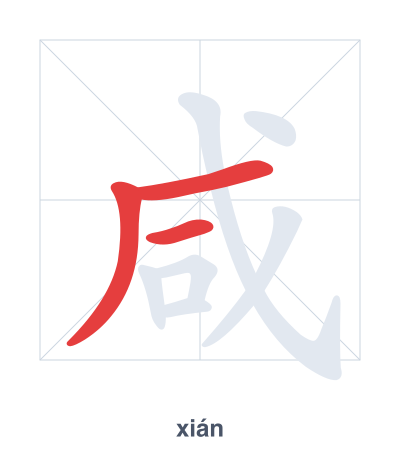
Open Hanzi Writer to see the animated stroke order and practice writing 咸 with real-time feedback.
The character 咸 (xián) is written with 9 strokes. Follow the standard Chinese stroke order: top to bottom, left to right, outside before inside. The radical 口 is one of its key components.
Practice the correct stroke order with the Hanzi Writer app to see animated stroke-by-stroke guidance with real-time feedback.
咸 means salty.
As an HSK Level 4 character, 咸 is an intermediate-level character.
咸 is a phono-semantic compound: 口 (mouth, indicating taste) serves as the semantic radical, while 戌 (xu) provides the pronunciation. Originally meaning 'all', it was later borrowed to denote the taste of salt, linking the mouth to the experience of saltiness.
💡 Memory Tip: Imagine a mouth (口) shaped like a salt lick, with the top part (戌) resembling a salt shaker pouring grains directly onto it.
我喜欢吃咸菜。
wǒ xǐ huān chī xián cài
I like eating pickles.
这个汤做得太咸了。
zhè ge tāng zuò dé tài xián le
This soup is too salty.
这里的咸鱼很好吃。
zhè lǐ de xián yú hěn hǎo chī
The salted fish here is delicious.
Open Hanzi Writer to see the animated stroke order and practice writing 咸 with real-time feedback.
✨ Animated stroke order · Handwriting recognition · HSK-graded practice · Free to use
咸 combines the radical 口 (mouth) on the outside with a simplified form of 戌 (a halberd) inside. The mouth suggests taste, so 咸 indicates "salty" as a flavor perceived by the mouth, while the internal part hints at a salty, preserved food origin.