菜 (cài) means "vegetable; dish; cuisine" in Chinese. It has 11 strokes with the radical 艹, and is HSK Level 1.
Rated 3.7/5 in difficulty (challenging).
Harder than 96% of HSK Level 1 characters.
Appears in 3+ common words including 白菜 (bái cài), 点菜 (diǎn cài), 做菜 (zuò cài).
Due to its 11 strokes, Hanzi Writer's error detection shows 菜 requires focused practice — most learners need 10+ attempts for consistent accuracy.
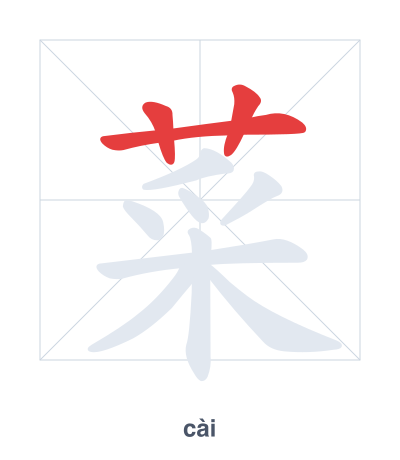
Open Hanzi Writer to see the animated stroke order and practice writing 菜 with real-time feedback.
The character 菜 (cài) is written with 11 strokes. Follow the standard Chinese stroke order: top to bottom, left to right, outside before inside. The radical 艹 is one of its key components.
Practice the correct stroke order with the Hanzi Writer app to see animated stroke-by-stroke guidance with real-time feedback.
菜 means vegetable; dish; cuisine.
As an HSK Level 1 character, 菜 is among the first characters beginners learn.
菜 is a compound character: the radical 艹 (grass/plant) indicates it relates to plants, while 采 (cǎi, to pick/gather) adds both sound and meaning—vegetables are plants that people pick for food.
💡 Memory Tip: Imagine your hand (采) plucking fresh leaves (艹) from the garden to prepare a tasty vegetable dish.
我喜欢吃白菜。
wǒ xǐ huān chī bái cài
I like eating Chinese cabbage.
我们现在点菜吧。
wǒ men xiàn zài diǎn cài ba
Let's order now.
妈妈正在做菜。
mā mā zhèng zài zuò cài
Mom is cooking.
Open Hanzi Writer to see the animated stroke order and practice writing 菜 with real-time feedback.
✨ Animated stroke order · Handwriting recognition · HSK-graded practice · Free to use
菜 is made of two parts: the radical 艹 (grass/plant) on top, and 采 (cǎi, meaning 'to pick') below. The plant radical connects to vegetables, while 采 suggests the action of picking or gathering, together indicating vegetables that are picked from the ground.