趣 (qù) means "Interest; fun." in Chinese. It has 15 strokes with the radical 走, and is HSK Level 4.
Rated 4.2/5 in difficulty (advanced).
Harder than 93% of HSK Level 4 characters.
Appears in 3+ common words including 有趣 (yǒu qù), 兴趣 (xìng qù), 趣味 (qù wèi).
Due to its 15 strokes, Hanzi Writer's error detection shows 趣 requires focused practice — most learners need 10+ attempts for consistent accuracy.
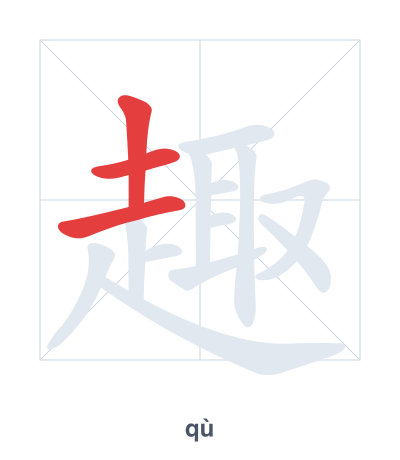
Open Hanzi Writer to see the animated stroke order and practice writing 趣 with real-time feedback.
The character 趣 (qù) is written with 15 strokes. Follow the standard Chinese stroke order: top to bottom, left to right, outside before inside. The radical 走 is one of its key components.
Practice the correct stroke order with the Hanzi Writer app to see animated stroke-by-stroke guidance with real-time feedback.
趣 means Interest; fun..
As an HSK Level 4 character, 趣 is an intermediate-level character.
趣 is a phono-semantic compound: the radical 走 (walk) suggests movement toward something, while 取 (qǔ, 'take') gives the sound. Originally it meant 'to hasten' or 'to go quickly,' but later shifted to mean 'interest' or 'fun'—something that draws you in and makes you move eagerly toward it.
💡 Memory Tip: Imagine walking (走) quickly to take (取) the last ticket to the funniest show in town.
这个电影很有趣。
zhè ge diàn yǐng hěn yǒu qù
This movie is very interesting.
我对他没兴趣。
wǒ duì tā méi xìng qù
I'm not interested in him.
这本书很有趣味。
zhè běn shū hěn yǒu qù wèi
This book is very interesting.
Open Hanzi Writer to see the animated stroke order and practice writing 趣 with real-time feedback.
✨ Animated stroke order · Handwriting recognition · HSK-graded practice · Free to use
趣 is composed of the radical 走 (walk) on the left and 取 (take) on the right. The 走 radical indicates movement or action, while 取 suggests taking or obtaining something, together implying going after something enjoyable. This structural combination conveys the idea of pursuing interest or fun.