趔 (liè) means "To stumble; to stagger." in Chinese. It has 13 strokes with the radical 走.
Rated 4.2/5 in difficulty (advanced).
Appears in 3+ common words including 趔趄 (liè qiè), 趔了一步 (liè le yī bù), 趔趔趄趄 (liè liè qiè jū).
Due to its 13 strokes, Hanzi Writer's error detection shows 趔 requires focused practice — most learners need 10+ attempts for consistent accuracy.
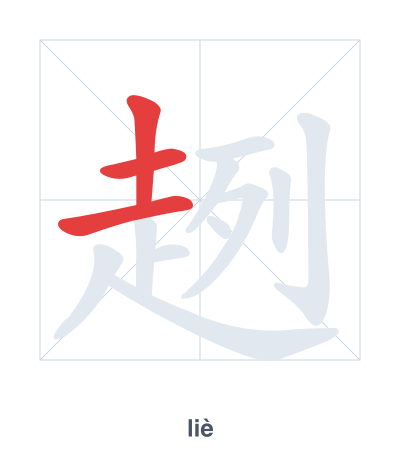
Open Hanzi Writer to see the animated stroke order and practice writing 趔 with real-time feedback.
The character 趔 (liè) is written with 13 strokes. Follow the standard Chinese stroke order: top to bottom, left to right, outside before inside. The radical 走 is one of its key components.
Practice the correct stroke order with the Hanzi Writer app to see animated stroke-by-stroke guidance with real-time feedback.
趔 means To stumble; to stagger..
| Character | 趔 |
| Pinyin | liè (lie) |
| Meaning | To stumble; to stagger. |
| Strokes | 13 |
| Radical | 走 |
| Difficulty | 4.2/5 |
The character 趔 combines the radical 走 (to walk) with the phonetic component 列 (liè, meaning 'to arrange'). The walking radical suggests motion, while the phonetic hints at pronunciation; together they depict an unsteady, staggering gait, like a walker whose steps are out of order.
💡 Memory Tip: Picture a person walking (走) in a straight line (列) but suddenly lurching sideways—that '列' becomes a diagonal stumble.
他差点打个趔趄。
tā chà diǎn dǎ gè liè qiè
He almost stumbled.
他向后趔了一步。
tā xiàng hòu liè le yī bù
He took a step back.
他趔趔趄趄地走着。
tā liè liè qiè jū dì zǒu zhe
He was walking unsteadily.
Open Hanzi Writer to see the animated stroke order and practice writing 趔 with real-time feedback.
✨ Animated stroke order · Handwriting recognition · HSK-graded practice · Free to use
趔 is a semantic-phonetic compound. The left part 走 means "walk" and gives the general meaning of movement, while the right part 列 provides the pronunciation liè and also suggests a sense of being unsteady or broken. Together, they create the idea of walking in a stumbling or staggering way.