超 (chāo) means "to exceed; to surpass; super-" in Chinese. It has 12 strokes with the radical 走, and is HSK Level 2.
Rated 3.7/5 in difficulty (challenging).
Harder than 95% of HSK Level 2 characters.
Appears in 3+ common words including 超市 (chāo shì), 超过 (chāo guò), 超人 (chāo rén).
Due to its 12 strokes, Hanzi Writer's error detection shows 超 requires focused practice — most learners need 10+ attempts for consistent accuracy.
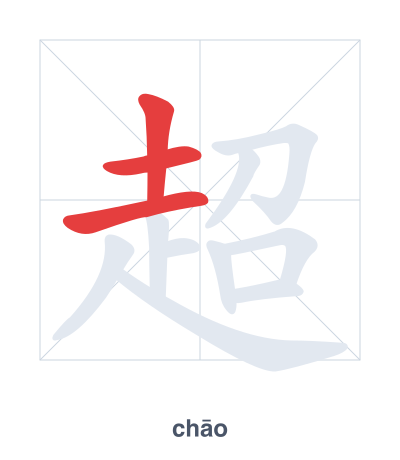
Open Hanzi Writer to see the animated stroke order and practice writing 超 with real-time feedback.
The character 超 (chāo) is written with 12 strokes. Follow the standard Chinese stroke order: top to bottom, left to right, outside before inside. The radical 走 is one of its key components.
Practice the correct stroke order with the Hanzi Writer app to see animated stroke-by-stroke guidance with real-time feedback.
超 means to exceed; to surpass; super-.
As an HSK Level 2 character, 超 is among the first characters beginners learn.
超 combines the radical 走 (to walk/run) with 召 (to summon, also phonetic). It originally depicted someone running so fast they "summon" their speed to go beyond or surpass a limit. The idea is motion that exceeds a boundary.
💡 Memory Tip: Picture a runner (走) leaping over a giant summons (召) as if to say, "I'm beyond your call!"
超市在哪里?
chāo shì zài nǎ lǐ
Where is the supermarket?
别超过他。
bié chāo guò tā
Don't overtake him.
他是超人。
tā shì chāo rén
He is Superman.
Open Hanzi Writer to see the animated stroke order and practice writing 超 with real-time feedback.
✨ Animated stroke order · Handwriting recognition · HSK-graded practice · Free to use
超 is made of two parts: the radical 走 on the left and 召 on the right. 走 means 'to walk' or 'to run', suggesting movement, while 召 gives the pronunciation hint (chāo). Together, they convey the idea of moving quickly to go beyond or surpass something.