起 (qǐ) means "to rise; to get up; to start" in Chinese. It has 10 strokes with the radical 走, and is HSK Level 1.
Rated 3.7/5 in difficulty (challenging).
Harder than 97% of HSK Level 1 characters.
Appears in 3+ common words including 起床 (qǐ chuáng), 一起 (yì qǐ), 起来 (qǐ lái).
Due to its 10 strokes, Hanzi Writer's error detection shows 起 requires focused practice — most learners need 10+ attempts for consistent accuracy.
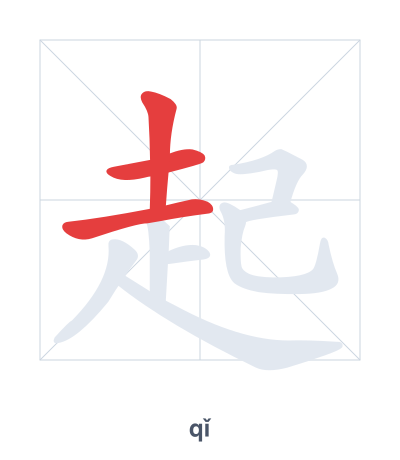
Open Hanzi Writer to see the animated stroke order and practice writing 起 with real-time feedback.
The character 起 (qǐ) is written with 10 strokes. Follow the standard Chinese stroke order: top to bottom, left to right, outside before inside. The radical 走 is one of its key components.
Practice the correct stroke order with the Hanzi Writer app to see animated stroke-by-stroke guidance with real-time feedback.
起 means to rise; to get up; to start.
As an HSK Level 1 character, 起 is among the first characters beginners learn.
起 combines the radical 走 (walking feet) with 己 (a kneeling person), depicting the act of rising from a kneeling position and beginning to walk. This illustrates the transition from stillness to movement, capturing the meanings 'to rise' and 'to start'.
💡 Memory Tip: Picture yourself (己) jumping up to run (走) as the starting signal goes off.
我六点起床。
wǒ liù diǎn qǐ chuáng
I get up at six o'clock.
我们一起去。
wǒ men yì qǐ qù
We'll go together.
请站起来。
qǐng zhàn qǐ lái
Please stand up.
Open Hanzi Writer to see the animated stroke order and practice writing 起 with real-time feedback.
✨ Animated stroke order · Handwriting recognition · HSK-graded practice · Free to use
起 is made of the radical 走 (walking) on the left and the component 巳 (snake/self) on the right. The 走 part suggests movement, and together the character conveys the idea of moving upward or beginning, as in "to rise" or "to get up."