味 (wèi) means "taste / flavor / smell" in Chinese. It has 8 strokes with the radical 口, and is HSK Level 2.
Rated 3.2/5 in difficulty (challenging).
Harder than 44% of HSK Level 2 characters.
Appears in 3+ common words including 味道 (wèi dào), 香味 (xiāng wèi), 趣味 (qù wèi).
Due to its 8 strokes, Hanzi Writer's error detection shows 味 requires focused practice — most learners need 10+ attempts for consistent accuracy.
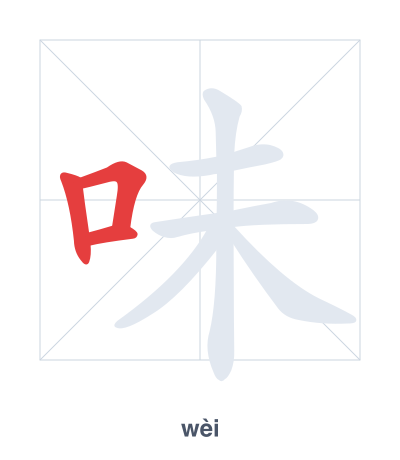
Open Hanzi Writer to see the animated stroke order and practice writing 味 with real-time feedback.
The character 味 (wèi) is written with 8 strokes. Follow the standard Chinese stroke order: top to bottom, left to right, outside before inside. The radical 口 is one of its key components.
Practice the correct stroke order with the Hanzi Writer app to see animated stroke-by-stroke guidance with real-time feedback.
味 means taste / flavor / smell.
As an HSK Level 2 character, 味 is among the first characters beginners learn.
味 is a phono-semantic compound combining the radical 口 (mouth) with 未 (wèi), which provides the pronunciation. The mouth is the organ that perceives taste and smell, so the character directly links the act of tasting to the spoken sound.
💡 Memory Tip: Imagine your mouth (口) tasting something new (未, meaning 'not yet') to discover its unexpected flavor.
这个菜的味道很好。
zhè ge cài de wèi dào hěn hǎo
The flavor of this dish is very good.
我闻到了花的香味。
wǒ wén dào le huā de xiāng wèi
I smelled the fragrance of flowers.
这本书很有趣味。
zhè běn shū hěn yǒu qù wèi
This book is very interesting.
Open Hanzi Writer to see the animated stroke order and practice writing 味 with real-time feedback.
✨ Animated stroke order · Handwriting recognition · HSK-graded practice · Free to use
味 is made of two parts: the radical 口 (mouth) on the left and 未 (wèi) on the right. The 口 shows that this character is related to the mouth or senses, while 未 gives the pronunciation. Together, they create the meaning of taste, flavor, or smell.