走 (zǒu) means "To walk / To go" in Chinese. It has 7 strokes with the radical 走, and is HSK Level 1.
Rated 2.7/5 in difficulty (moderate).
Harder than 48% of HSK Level 1 characters.
Appears in 3+ common words including 走路 (zǒu lù), 走了 (zǒu le), 走吧 (zǒu ba).
Hanzi Writer's stroke validation shows learners typically need 5-8 attempts to write 走 with correct proportion and order.
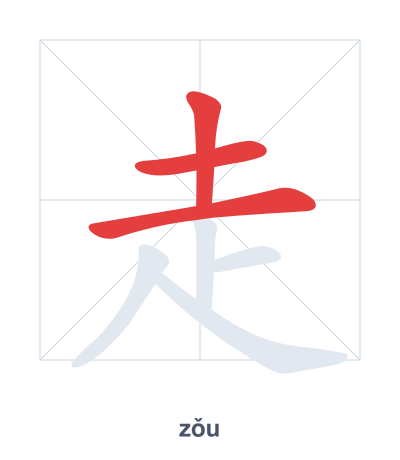
Open Hanzi Writer to see the animated stroke order and practice writing 走 with real-time feedback.
The character 走 (zǒu) is written with 7 strokes. Follow the standard Chinese stroke order: top to bottom, left to right, outside before inside. The radical 走 is one of its key components.
Practice the correct stroke order with the Hanzi Writer app to see animated stroke-by-stroke guidance with real-time feedback.
走 means To walk / To go.
As an HSK Level 1 character, 走 is among the first characters beginners learn.
The character 走 originally depicted a person running with arms swinging, combining a human figure (similar to 大 but with a bent arm) and a footprint (止) at the bottom, meaning 'to run' in ancient times; over time its meaning shifted to 'to walk' or 'to go'.
💡 Memory Tip: Picture a person with big swinging arms (the top part) and a stamping foot (止) taking a bold stride forward—that's 走, walking with determination.
走路对身体好。
zǒu lù duì shēn tǐ hǎo
Walking is good for your health.
他已经走了。
tā yǐ jīng zǒu le
He has already left.
我们现在走吧。
wǒ men xiàn zài zǒu ba
Let's go now.
Open Hanzi Writer to see the animated stroke order and practice writing 走 with real-time feedback.
✨ Animated stroke order · Handwriting recognition · HSK-graded practice · Free to use
The character 走 combines the radical 走 on the left side and a component that looks like 止 (stop) underneath. Historically, it depicts a person swinging their arms while walking, which relates to the meaning 'to walk' or 'to go'.