趁 (chèn) means "to take advantage of (time or opportunity)" in Chinese. It has 12 strokes with the radical 走, and is HSK Level 7.
Rated 4.2/5 in difficulty (advanced).
Harder than 91% of HSK Level 7 characters.
Appears in 3+ common words including 趁热 (chèn rè), 趁早 (chèn zǎo), 趁机 (chèn jī).
Due to its 12 strokes, Hanzi Writer's error detection shows 趁 requires focused practice — most learners need 10+ attempts for consistent accuracy.
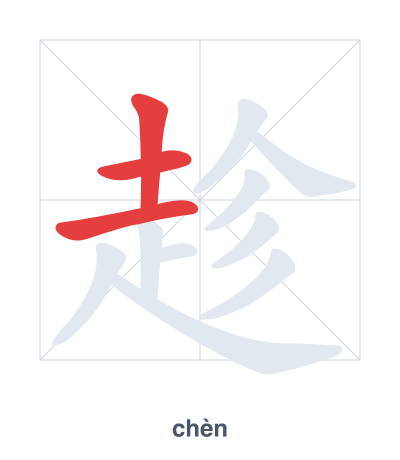
Open Hanzi Writer to see the animated stroke order and practice writing 趁 with real-time feedback.
The character 趁 (chèn) is written with 12 strokes. Follow the standard Chinese stroke order: top to bottom, left to right, outside before inside. The radical 走 is one of its key components.
Practice the correct stroke order with the Hanzi Writer app to see animated stroke-by-stroke guidance with real-time feedback.
趁 means to take advantage of (time or opportunity).
As an HSK Level 7 character, 趁 is an intermediate-level character.
趁 combines the radical 走 (to walk/run) with 刍 (chú, meaning 'cut grass' or 'fodder'), originally suggesting the idea of chasing after something or someone. Over time, its meaning shifted to 'taking advantage of a moment or opportunity,' much like rushing to seize a fleeting chance. The character visually depicts swift movement (走) toward a goal (刍).
💡 Memory Tip: Imagine sprinting (走) to grab a bundle of fresh grass (刍) before others can—you're taking advantage of the moment.
趁热吃吧。
chèn rè chī ba
Eat it while it's hot.
趁早回家。
chèn zǎo huí jiā
Go home as early as possible.
趁机逃跑。
chèn jī táo pǎo
To take the chance to escape.
Open Hanzi Writer to see the animated stroke order and practice writing 趁 with real-time feedback.
✨ Animated stroke order · Handwriting recognition · HSK-graded practice · Free to use
趁 is composed of the radical 走 (to walk) on the left and the phonetic component 刍 (chú) on the right. The 走 radical indicates movement or action, while the overall character means to take advantage of a moment, like "walking into" an opportunity.