趟 (tāng/tàng) means "Trip; (measure word for trips)." in Chinese. It has 15 strokes with the radical 走, and is HSK Level 6.
Rated 4.2/5 in difficulty (advanced).
Harder than 91% of HSK Level 6 characters.
Appears in 4+ common words including 走一趟 (zǒu yī tàng), 这趟车 (zhè tàng chē), 跑一趟 (pǎo yī tàng).
Due to its 15 strokes, Hanzi Writer's error detection shows 趟 requires focused practice — most learners need 10+ attempts for consistent accuracy.
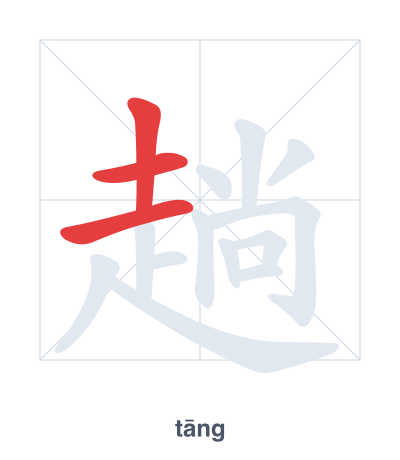
Open Hanzi Writer to see the animated stroke order and practice writing 趟 with real-time feedback.
The character 趟 (tāng/tàng) is written with 15 strokes. Follow the standard Chinese stroke order: top to bottom, left to right, outside before inside. The radical 走 is one of its key components.
Practice the correct stroke order with the Hanzi Writer app to see animated stroke-by-stroke guidance with real-time feedback.
趟 means Trip; (measure word for trips)..
This is a polyphonic character with readings: tāng, tàng.
As an HSK Level 6 character, 趟 is an intermediate-level character.
趟 is a compound character where the radical 走 ('walk') indicates movement, and the phonetic component 尚 (originally meaning 'still' or 'yet') provides the sound tāng. Together, they convey the idea of walking a distance, hence a 'trip' or a measure word for trips.
💡 Memory Tip: Picture a person walking (走) while carrying a small house (尚) on their back—each step is a trip to a new place.
我去超市走一趟。
wǒ qù chāo shì zǒu yī tàng
I'm going to take a trip to the supermarket.
这趟车去北京。
zhè tàng chē qù běi jīng
This train goes to Beijing.
麻烦你跑一趟了。
má fán nǐ pǎo yī tàng le
Sorry to trouble you to make the trip.
我们趟水过河。
wǒ men tāng shuǐ guò hé
We waded across the river.
Open Hanzi Writer to see the animated stroke order and practice writing 趟 with real-time feedback.
✨ Animated stroke order · Handwriting recognition · HSK-graded practice · Free to use
趟 combines the radical 走 (walking) on the left with 尚 on the right. The 走 radical indicates movement, and together with 尚 (which provides the pronunciation tāng), the character conveys the idea of a trip or journey. So the structure suggests 'walking to make a trip.'