赴 (fù) means "To go to; to attend." in Chinese. It has 9 strokes with the radical 走, and is HSK Level 7.
Rated 4/5 in difficulty (challenging).
Harder than 46% of HSK Level 7 characters.
Appears in 3+ common words including 赴约 (fù yuē), 赴美 (fù měi), 赴宴 (fù yàn).
Due to its 9 strokes, Hanzi Writer's error detection shows 赴 requires focused practice — most learners need 10+ attempts for consistent accuracy.
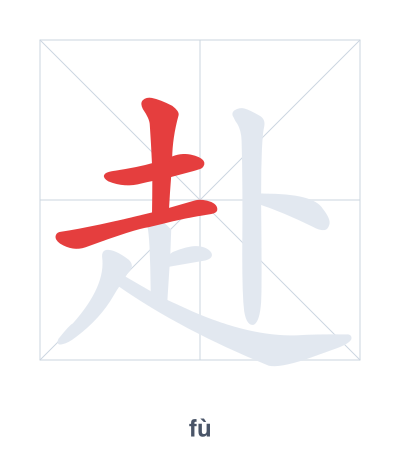
Open Hanzi Writer to see the animated stroke order and practice writing 赴 with real-time feedback.
The character 赴 (fù) is written with 9 strokes. Follow the standard Chinese stroke order: top to bottom, left to right, outside before inside. The radical 走 is one of its key components.
Practice the correct stroke order with the Hanzi Writer app to see animated stroke-by-stroke guidance with real-time feedback.
赴 means To go to; to attend..
As an HSK Level 7 character, 赴 is an intermediate-level character.
赴 combines the radical 走 (walking/running) with the phonetic 卜 (bǔ, divination). The 走 radical, derived from a pictograph of a running person, conveys the idea of hurrying to a place, while 卜 hints at the sound and originally reinforced the notion of going to consult an oracle, evolving to simply 'go to' or 'attend'.
💡 Memory Tip: Imagine you're rushing (走) to attend a fortune-telling (卜) appointment, so you 'go to' 赴 the event.
他去赴约了。
tā qù fù yuē le
He went to keep an appointment.
他赴美留学。
tā fù měi liú xué
He went to study in the United States.
我要去赴宴。
wǒ yào qù fù yàn
I'm going to attend a banquet.
Open Hanzi Writer to see the animated stroke order and practice writing 赴 with real-time feedback.
✨ Animated stroke order · Handwriting recognition · HSK-graded practice · Free to use
赴 is made of the radical 走 (to walk) on the left and the phonetic component 卜 (bǔ) on the right. The 走 radical indicates movement, so 赴 means "to go to" a place or event. The right part gives a hint to the pronunciation fù.