有 (yǒu) means "to have; there is; there are" in Chinese. It has 6 strokes with the radical 月, and is HSK Level 1.
Rated 2.7/5 in difficulty (moderate).
Harder than 45% of HSK Level 1 characters.
Appears in 3+ common words including 有钱 (yǒu qián), 没有 (méi yǒu), 有名 (yǒu míng).
Hanzi Writer's stroke validation shows learners typically need 5-8 attempts to write 有 with correct proportion and order.
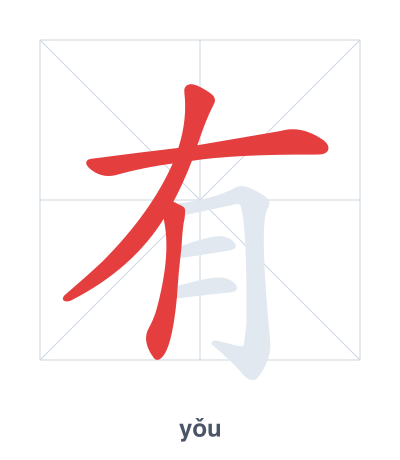
Open Hanzi Writer to see the animated stroke order and practice writing 有 with real-time feedback.
The character 有 (yǒu) is written with 6 strokes. Follow the standard Chinese stroke order: top to bottom, left to right, outside before inside. The radical 月 is one of its key components.
Practice the correct stroke order with the Hanzi Writer app to see animated stroke-by-stroke guidance with real-time feedback.
有 means to have; there is; there are.
As an HSK Level 1 character, 有 is among the first characters beginners learn.
In ancient oracle bone script, 有 depicted a hand (又) holding a piece of meat (肉, later simplified to 月) to represent possession. The modern character combines the meat radical 月 on top with the hand 又 below, symbolizing 'to have' or 'there is'.
💡 Memory Tip: Imagine you have a moon (月) in your hand (又) - you possess a celestial treasure.
他很有钱。
tā hěn yǒu qián
He is very rich.
我没有手机。
wǒ méi yǒu shǒu jī
I don't have a cell phone.
这个地方很有名。
zhè ge dì fāng hěn yǒu míng
This place is very famous.
Open Hanzi Writer to see the animated stroke order and practice writing 有 with real-time feedback.
✨ Animated stroke order · Handwriting recognition · HSK-graded practice · Free to use
有 is made of two parts: the radical 月 (which often represents meat or body parts) on the left, and 又 (a hand) on the right. Together, they suggest holding meat in your hand, which connects to the meaning of 'to have' or 'to possess'.