瞧 (qiáo) means "to look; to see (colloquial)" in Chinese. It has 17 strokes with the radical 目, and is HSK Level 5.
Rated 4.2/5 in difficulty (advanced).
Harder than 83% of HSK Level 5 characters.
Appears in 3+ common words including 瞧一瞧 (qiáo yī qiáo), 瞧见 (qiáo jiàn), 瞧不起 (qiáo bù qǐ).
Due to its 17 strokes, Hanzi Writer's error detection shows 瞧 requires focused practice — most learners need 10+ attempts for consistent accuracy.
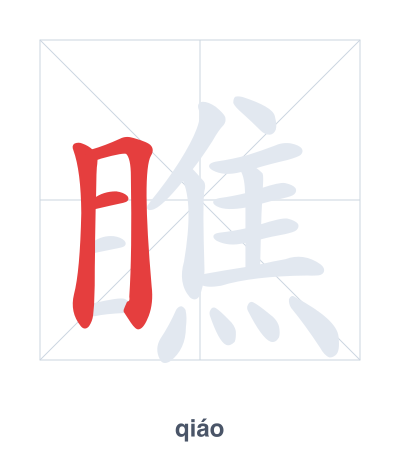
Open Hanzi Writer to see the animated stroke order and practice writing 瞧 with real-time feedback.
The character 瞧 (qiáo) is written with 17 strokes. Follow the standard Chinese stroke order: top to bottom, left to right, outside before inside. The radical 目 is one of its key components.
Practice the correct stroke order with the Hanzi Writer app to see animated stroke-by-stroke guidance with real-time feedback.
瞧 means to look; to see (colloquial).
As an HSK Level 5 character, 瞧 is an intermediate-level character.
It is a compound character combining the radical 目 (eye) with the phonetic component 焦 (meaning 'scorched'), suggesting looking so intently that one's gaze feels intense or focused.
💡 Memory Tip: Picture a person squinting their eye (目) at a scorching flame (焦) to see something clearly.
你过来瞧一瞧。
nǐ guò lái qiáo yī qiáo
Come over and take a look.
我瞧见他进屋了。
wǒ qiáo jiàn tā jìn wū le
I saw him enter the room.
别瞧不起人。
bié qiáo bù qǐ rén
Don't look down on others.
Open Hanzi Writer to see the animated stroke order and practice writing 瞧 with real-time feedback.
✨ Animated stroke order · Handwriting recognition · HSK-graded practice · Free to use
瞧 is a left-right compound: the left part is 目 (eye radical), showing the meaning is related to seeing. The right part is 焦, which originally means "burn" but here mainly gives the sound (qiáo). Together, the character means "to look" or "to see" in a colloquial, everyday way.