Hanzi Writer

How to Write 嚏 (tì) — Meaning “Sneeze”

17 strokes Radical: 口

嚏 (tì) means "Sneeze" in Chinese. It has 17 strokes with the radical 口.

Rated 4.2/5 in difficulty (advanced).

Appears in 3+ common words including 打喷嚏 (dǎ pēn tì), 喷嚏 (pēn tì), 嚏喷 (tì pēn).

Due to its 17 strokes, Hanzi Writer's error detection shows 嚏 requires focused practice — most learners need 10+ attempts for consistent accuracy.
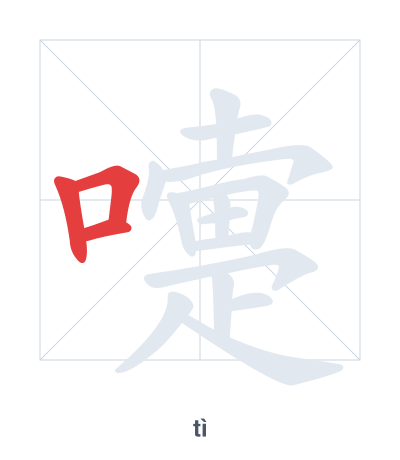
Stroke order practice for 嚏 - tì

Practice Writing 嚏 (tì)

Open Hanzi Writer to see the animated stroke order and practice writing 嚏 with real-time feedback.

The character (tì) is written with 17 strokes. Follow the standard Chinese stroke order: top to bottom, left to right, outside before inside. The radical is one of its key components.

Practice the correct stroke order with the Hanzi Writer app to see animated stroke-by-stroke guidance with real-time feedback.

means Sneeze.

Character
Pinyintì (ti)
MeaningSneeze
Strokes17
Radical
Difficulty4.2/5

This character is a compound with the mouth radical (口) indicating an action involving the mouth—sneezing produces a sound from the mouth. The right component 疐 (zhì) originally meant 'to stumble' but here serves as a phonetic clue for the pronunciation 'tì'.

💡 Memory Tip: Picture someone sneezing so violently that they stumble (疐) while covering their mouth (口), with their foot (疋) lashing out like an arrow (矢).

dǎ pēn tì
to sneeze
pēn tì
sneeze
tì pēn
Sneeze (colloquial)

我一直在打喷嚏。

wǒ yì zhí zài dǎ pēn tì

I have been sneezing.

他打了一个喷嚏。

tā dǎ le yí gè pēn tì

He sneezed.

感冒会让人打嚏喷。

gǎn mào huì ràng rén dǎ tì pēn

A cold makes people sneeze.

Character Pinyin Strokes Radical
(current) 17
chuài 15
pēng 15
zhǔ 15
Stroke order practice for 嚏 - tì

Practice Writing 嚏 (tì)

Open Hanzi Writer to see the animated stroke order and practice writing 嚏 with real-time feedback.

✨ Animated stroke order · Handwriting recognition · HSK-graded practice · Free to use

Frequently Asked Questions about 嚏

The character 嚏 is composed of the mouth radical 口 on the left, and a phonetic component on the right. The mouth radical directly links to the action of sneezing, which involves the mouth. The right part provides a hint to the pronunciation "tì" but does not carry meaning.

Characters with Radical 口

Other 17-Stroke Characters