嬷 (mā) means "Mother; nanny; old woman" in Chinese. It has 17 strokes with the radical 女.
Rated 4.2/5 in difficulty (advanced).
Appears in 3+ common words including 嬷嬷 (mā mā), 奶嬷嬷 (nǎi mā mā), 老嬷嬷 (lǎo mā mā).
Due to its 17 strokes, Hanzi Writer's error detection shows 嬷 requires focused practice — most learners need 10+ attempts for consistent accuracy.
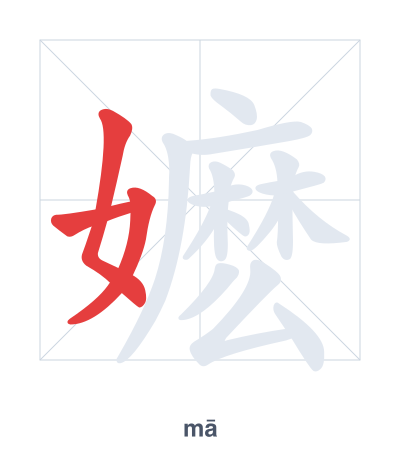
Open Hanzi Writer to see the animated stroke order and practice writing 嬷 with real-time feedback.
The character 嬷 (mā) is written with 17 strokes. Follow the standard Chinese stroke order: top to bottom, left to right, outside before inside. The radical 女 is one of its key components.
Practice the correct stroke order with the Hanzi Writer app to see animated stroke-by-stroke guidance with real-time feedback.
嬷 means Mother; nanny; old woman.
This compound character combines the radical 女 (woman, female) with 麻 (má, hemp) which provides the sound. The meaning 'mother, nanny, old woman' likely derives from associating a woman (女) with practical household work like handling hemp (麻), hence an elderly or nurturing female figure.
💡 Memory Tip: Picture an old woman (女) knitting a coarse cloth from hemp (麻) fibers, rocking a baby with her foot—that’s your loving 嬷 (mother or nanny).
嬷嬷在厨房里。
mā mā zài chú fáng lǐ
The nanny is in the kitchen.
奶嬷嬷照顾孩子。
nǎi mā mā zhào gù hái zi
The wet nurse takes care of the child.
那位老嬷嬷很慈祥。
nà wèi lǎo mā mā hěn cí xiáng
That old nanny is very kind.
Open Hanzi Writer to see the animated stroke order and practice writing 嬷 with real-time feedback.
✨ Animated stroke order · Handwriting recognition · HSK-graded practice · Free to use
The character 嬷 is made of the radical 女 (woman) on the left and 麻 (hemp) on the right. The woman radical suggests a female role, while the hemp component hints at domestic work like weaving, together showing an older woman or nanny who does household tasks. This structure explains why 嬷 means mother, nanny, or old woman.