盹 (dǔn) means "nap / doze" in Chinese. It has 9 strokes with the radical 目, and is HSK Level 7.
Rated 4/5 in difficulty (challenging).
Harder than 43% of HSK Level 7 characters.
Appears in 3+ common words including 打盹 (dǎ dǔn), 盹儿 (dǔn er), 眯一盹 (mī yī dǔn).
Due to its 9 strokes, Hanzi Writer's error detection shows 盹 requires focused practice — most learners need 10+ attempts for consistent accuracy.
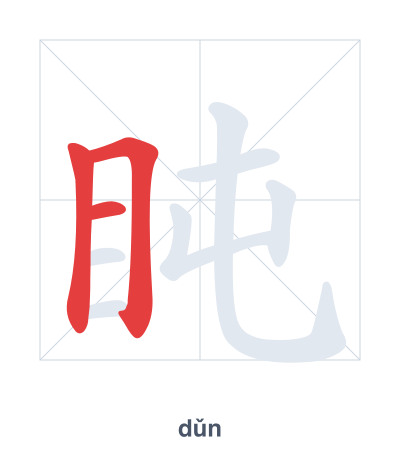
Open Hanzi Writer to see the animated stroke order and practice writing 盹 with real-time feedback.
The character 盹 (dǔn) is written with 9 strokes. Follow the standard Chinese stroke order: top to bottom, left to right, outside before inside. The radical 目 is one of its key components.
Practice the correct stroke order with the Hanzi Writer app to see animated stroke-by-stroke guidance with real-time feedback.
盹 means nap / doze.
As an HSK Level 7 character, 盹 is an intermediate-level character.
盹 is a compound character combining the radical 目 (eye) and the phonetic component 屯 (dūn), which suggests the sound. The eye radical links the character to vision, specifically the act of dozing off with eyes heavy and half-closed.
💡 Memory Tip: Picture your eye (目) slowly sinking into a drowsy pile (屯) as you start to doze off.
他在沙发上打盹。
tā zài shā fā shàng dǎ dǔn
He is napping on the sofa.
我想打个盹儿。
wǒ xiǎng dǎ gè dǔn er
I want to take a nap.
累了就去眯一盹吧。
lèi le jiù qù mī yī dǔn ba
If you're tired, go take a nap.
Open Hanzi Writer to see the animated stroke order and practice writing 盹 with real-time feedback.
✨ Animated stroke order · Handwriting recognition · HSK-graded practice · Free to use
盹 combines the radical 目 (eye) on the left and the component 屯 (tún) on the right. The eye radical directly links to the meaning of napping or dozing, since closing your eyes is part of sleeping. The right side 屯 provides the pronunciation hint dǔn.