盯 (dīng) means "stare / gaze" in Chinese. It has 7 strokes with the radical 目, and is HSK Level 7.
Rated 3.5/5 in difficulty (challenging).
Harder than 20% of HSK Level 7 characters.
Appears in 3+ common words including 盯着 (dīng zhe), 盯住 (dīng zhù), 紧盯 (jǐn dīng).
Due to its 7 strokes, Hanzi Writer's error detection shows 盯 requires focused practice — most learners need 10+ attempts for consistent accuracy.
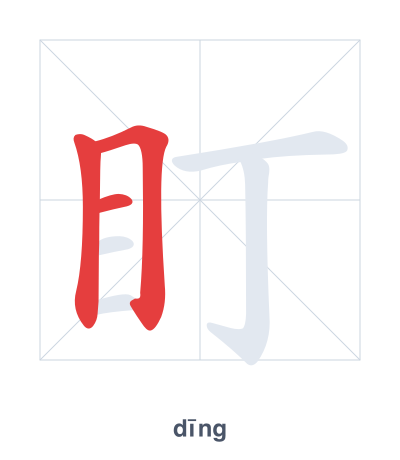
Open Hanzi Writer to see the animated stroke order and practice writing 盯 with real-time feedback.
The character 盯 (dīng) is written with 7 strokes. Follow the standard Chinese stroke order: top to bottom, left to right, outside before inside. The radical 目 is one of its key components.
Practice the correct stroke order with the Hanzi Writer app to see animated stroke-by-stroke guidance with real-time feedback.
盯 means stare / gaze.
As an HSK Level 7 character, 盯 is an intermediate-level character.
盯 combines the eye radical 目 (mù) with 丁 (dīng, meaning 'nail'). The eye with a nail suggests the action of fixing one's gaze firmly on an object, as if nailed to it.
💡 Memory Tip: Imagine a nail (丁) stuck right in front of your eye (目), forcing you to stare at it without blinking.
他一直盯着我看。
tā yì zhí dīng zhe wǒ kàn
He has been staring at me.
请盯住那个球。
qǐng dīng zhù nà ge qiú
Please keep your eye on the ball.
老师紧盯着学生。
lǎo shī jǐn dīng zhe xué shēng
The teacher kept a close eye on the students.
Open Hanzi Writer to see the animated stroke order and practice writing 盯 with real-time feedback.
✨ Animated stroke order · Handwriting recognition · HSK-graded practice · Free to use
盯 is made of the radical 目 (eye) on the left and the character 丁 (dīng, nail) on the right. The eye component connects the character to vision, while 丁 provides a phonetic hint for the pronunciation dīng. Together, they suggest the action of fixing your eyes on something, like a nail being fixed in place.