盱 (xū) means "gaze / stare (literary)" in Chinese. It has 8 strokes with the radical 目.
Rated 3.7/5 in difficulty (challenging).
Appears in 3+ common words including 盱眙 (xū yí), 盱衡 (xū héng), 盱望 (xū wàng).
Due to its 8 strokes, Hanzi Writer's error detection shows 盱 requires focused practice — most learners need 10+ attempts for consistent accuracy.
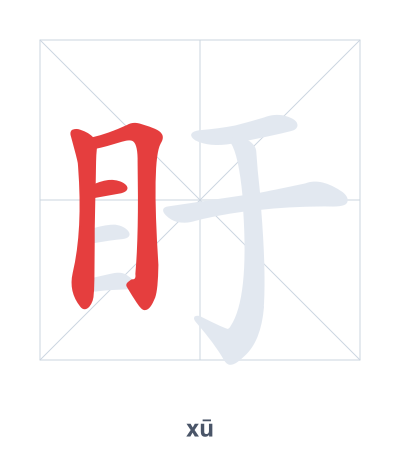
Open Hanzi Writer to see the animated stroke order and practice writing 盱 with real-time feedback.
The character 盱 (xū) is written with 8 strokes. Follow the standard Chinese stroke order: top to bottom, left to right, outside before inside. The radical 目 is one of its key components.
Practice the correct stroke order with the Hanzi Writer app to see animated stroke-by-stroke guidance with real-time feedback.
盱 means gaze / stare (literary).
盱 is a phono-semantic compound. The left radical 目 (eye) indicates the meaning relates to looking, while the right component 于 (yú) provides the pronunciation. Together, the character conveys the action of gazing or staring intently.
💡 Memory Tip: Imagine a wide eye (目) staring fixedly at a hook (于) dangling from a string, utterly captivated by its slow swing.
盱眙的小龙虾很有名。
xū yí de xiǎo lóng xiā hěn yǒu míng
Xuyi's crayfish is very famous.
我们要盱衡全局。
wǒ men yào xū héng quán jú
We need to take the whole situation into account.
他向远方盱望。
tā xiàng yuǎn fāng xū wàng
He looked into the distance.
Open Hanzi Writer to see the animated stroke order and practice writing 盱 with real-time feedback.
✨ Animated stroke order · Handwriting recognition · HSK-graded practice · Free to use
盱 is made of two parts: the left side is 目 (eye), which gives the meaning related to seeing. The right side is 于 (yú), which provides a clue to the pronunciation (xū via sound change). Together, the character means "to gaze" or "to stare," connecting the eye radical to the action of looking.