壑 (hè) means "ravine / gully" in Chinese. It has 17 strokes with the radical 土.
Rated 4.2/5 in difficulty (advanced).
Appears in 3+ common words including 沟壑 (gōu hè), 丘壑 (qiū hè), 壑口 (hè kǒu).
Due to its 17 strokes, Hanzi Writer's error detection shows 壑 requires focused practice — most learners need 10+ attempts for consistent accuracy.
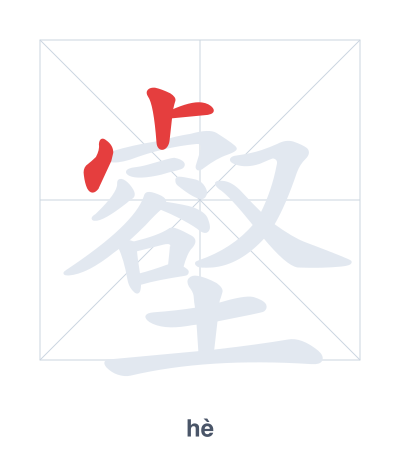
Open Hanzi Writer to see the animated stroke order and practice writing 壑 with real-time feedback.
The character 壑 (hè) is written with 17 strokes. Follow the standard Chinese stroke order: top to bottom, left to right, outside before inside. The radical 土 is one of its key components.
Practice the correct stroke order with the Hanzi Writer app to see animated stroke-by-stroke guidance with real-time feedback.
壑 means ravine / gully.
壑 combines 㕡 (a deep pit or hole) with 土 (earth), literally meaning a deep hollow in the ground, which visually represents a ravine or gully carved into the earth.
💡 Memory Tip: Imagine a huge, gaping ravine shaped like the top part 㕡, with the earth (土) below it ready to crumble in.
山间有很多沟壑。
shān jiān yǒu hěn duō gōu hè
There are many gullies and ravines in the mountains.
画家胸有丘壑。
huà jiā xiōng yǒu qiū hè
The painter has a grand vision.
溪水流向壑口。
xī shuǐ liú xiàng hè kǒu
The stream flows toward the mouth of the ravine.
Open Hanzi Writer to see the animated stroke order and practice writing 壑 with real-time feedback.
✨ Animated stroke order · Handwriting recognition · HSK-graded practice · Free to use
壑 is composed of three parts: the top left is 㕡 (a phonetic component), the top right is 又 (hand), and the bottom is 土 (earth). The combination suggests a hand digging into the earth, forming a ravine or gully.