嚓 (cā/chā) means "Snap / Click (onomatopoeia)" in Chinese. It has 17 strokes with the radical 口.
Rated 4.2/5 in difficulty (advanced).
Appears in 3+ common words including 咔嚓 (kā chā), 嚓的一声 (cā de yī shēng), 嚓嚓响 (cā cā xiǎng).
Due to its 17 strokes, Hanzi Writer's error detection shows 嚓 requires focused practice — most learners need 10+ attempts for consistent accuracy.
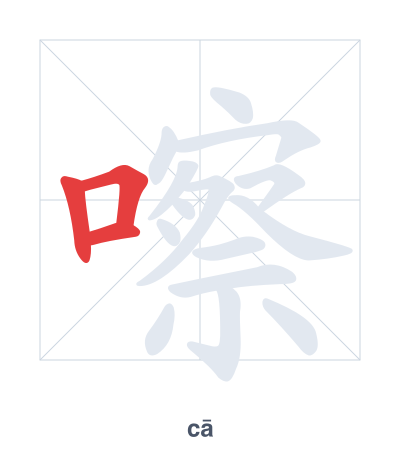
Open Hanzi Writer to see the animated stroke order and practice writing 嚓 with real-time feedback.
The character 嚓 (cā/chā) is written with 17 strokes. Follow the standard Chinese stroke order: top to bottom, left to right, outside before inside. The radical 口 is one of its key components.
Practice the correct stroke order with the Hanzi Writer app to see animated stroke-by-stroke guidance with real-time feedback.
嚓 means Snap / Click (onomatopoeia).
This is a polyphonic character with readings: cā, chā.
嚓 is a phono-semantic compound character combining the mouth radical (口), indicating a sound, with 察 (cā) which provides the pronunciation. The meaning 'snap/click' is an onomatopoeia for sudden sharp noises like a camera shutter or breaking twig.
💡 Memory Tip: A mouth (口) makes a loud snap as it inspects (察) a broken twig.
咔嚓,他拍了一张照片。
kā chā tā pāi le yī zhāng zhào piān
Click! He took a photo.
嚓的一声,火柴着了。
cā de yī shēng huǒ chái zhe le
With a scratch, the match lit.
树叶发出嚓嚓响声。
shù yè fā chū cā cā xiǎng shēng
The leaves are making a crunching sound.
Open Hanzi Writer to see the animated stroke order and practice writing 嚓 with real-time feedback.
✨ Animated stroke order · Handwriting recognition · HSK-graded practice · Free to use
The character 嚓 is composed of the radical 口 (mouth) on the left, showing it is a sound-related word, and the phonetic component 察 (chá, meaning "examine") on the right. The mouth radical indicates an onomatopoeic sound, while 察 gives the pronunciation clue, though the meaning "snap/click" comes from the whole character rather than its parts.