嚅 (rú) means "To mumble / To move one's lips" in Chinese. It has 17 strokes with the radical 口.
Rated 4.2/5 in difficulty (advanced).
Appears in 3+ common words including 嚅动 (rú dòng), 嚅嚅 (rú rú), 唯唯嚅嚅 (wéi wéi rú rú).
Due to its 17 strokes, Hanzi Writer's error detection shows 嚅 requires focused practice — most learners need 10+ attempts for consistent accuracy.
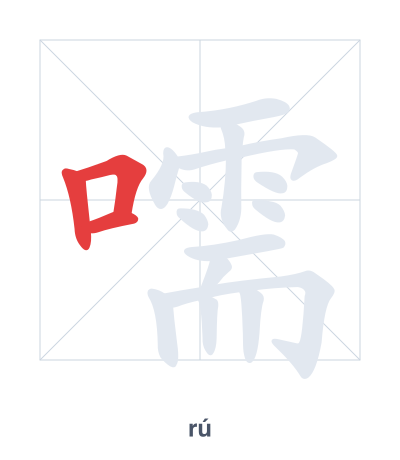
Open Hanzi Writer to see the animated stroke order and practice writing 嚅 with real-time feedback.
The character 嚅 (rú) is written with 17 strokes. Follow the standard Chinese stroke order: top to bottom, left to right, outside before inside. The radical 口 is one of its key components.
Practice the correct stroke order with the Hanzi Writer app to see animated stroke-by-stroke guidance with real-time feedback.
嚅 means To mumble / To move one's lips.
嚅 is a phono-semantic compound. The radical 口 (mouth) indicates the action is related to speaking, while 需 (rú) provides the pronunciation. Together, they depict the motion of lips mumbling or moving without clear speech.
💡 Memory Tip: Imagine a mouth (口) that needs (需) to mumble because rain (雨) is dripping onto your beard (而), making words blurry.
他的嘴唇在嚅动。
tā de zuǐ chún zài rú dòng
His lips are quivering.
他嚅嚅地说不出话。
tā rú rú dì shuō bù chū huà
He stammered and was unable to speak.
他说话唯唯嚅嚅的。
tā shuō huà wéi wéi rú rú de
He speaks submissively.
Open Hanzi Writer to see the animated stroke order and practice writing 嚅 with real-time feedback.
✨ Animated stroke order · Handwriting recognition · HSK-graded practice · Free to use
嚅 is composed of the radical 口 (mouth) on the left and the phonetic component 需 (xū) on the right. The 口 suggests the meaning involves the mouth, while 需 hints at the pronunciation rú. Together, they form the idea of mouth movements like mumbling.