不 (bú/bù) means "not; no" in Chinese. It has 4 strokes with the radical 一, and is HSK Level 1.
Rated 1.9/5 in difficulty (beginner-friendly).
Harder than 11% of HSK Level 1 characters.
Appears in 3+ common words including 不客气 (bú kè qì), 不好意思 (bù hǎo yì sī), 不去 (bù qù).
In the Hanzi Writer app, most learners master 不 within 3 practice attempts using stroke-by-stroke animation.
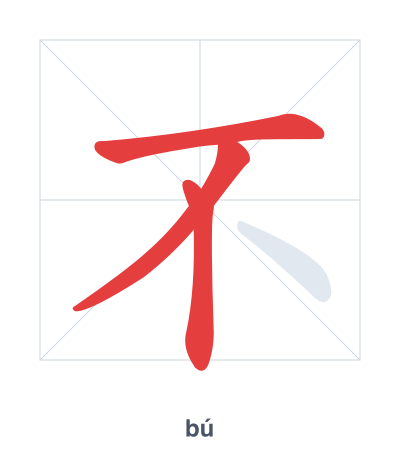
Open Hanzi Writer to see the animated stroke order and practice writing 不 with real-time feedback.
The character 不 (bú/bù) is written with 4 strokes. Follow the standard Chinese stroke order: top to bottom, left to right, outside before inside. The radical 一 is one of its key components.
Practice the correct stroke order with the Hanzi Writer app to see animated stroke-by-stroke guidance with real-time feedback.
不 means not; no.
This is a polyphonic character with readings: bú, bù.
As an HSK Level 1 character, 不 is among the first characters beginners learn.
In ancient oracle bone script, 不 depicted a calyx (the sepals of a flower) with a downward stroke, representing a flower that has not yet bloomed. This image of something incomplete or not yet done gave rise to the abstract meaning of negation: 'not' or 'no'.
💡 Memory Tip: Imagine a red 'no' symbol: a horizontal bar with a diagonal slash crossing it and a dot below, like a universal 'not allowed' sign.
不客气,这是我做的。
bú kè qì zhè shì wǒ zuò de
You're welcome, I made this.
不好意思,我今天不能参加聚会。
bù hǎo yì sī , wǒ jīn tiān bù néng cān jiā jù huì 。
Sorry, I cannot attend the party today.
我明天不去商店。
wǒ míng tiān bù qù shāng diàn
I'm not going to the store tomorrow.
Open Hanzi Writer to see the animated stroke order and practice writing 不 with real-time feedback.
✨ Animated stroke order · Handwriting recognition · HSK-graded practice · Free to use
The character 不 is composed of four strokes: a horizontal line (一) at the top, a left-falling stroke, a vertical stroke, and a dot. Although the radical is 一 (meaning 'one'), the shape itself does not directly picture 'not'; instead, it is an abstract symbol that has been used for negation since ancient times.