瞌 (kē) means "To doze" in Chinese. It has 15 strokes with the radical 目.
Rated 4.2/5 in difficulty (advanced).
Appears in 3+ common words including 打瞌睡 (dǎ kē shuì), 瞌睡 (kē shuì), 瞌睡虫 (kē shuì chóng).
Due to its 15 strokes, Hanzi Writer's error detection shows 瞌 requires focused practice — most learners need 10+ attempts for consistent accuracy.
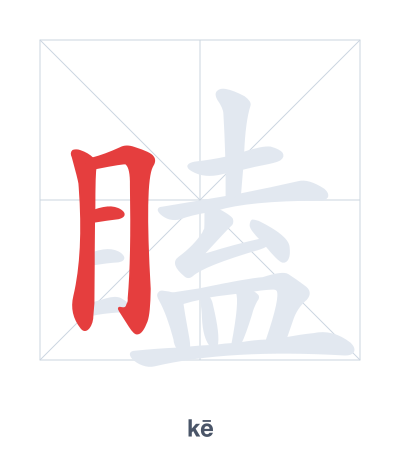
Open Hanzi Writer to see the animated stroke order and practice writing 瞌 with real-time feedback.
The character 瞌 (kē) is written with 15 strokes. Follow the standard Chinese stroke order: top to bottom, left to right, outside before inside. The radical 目 is one of its key components.
Practice the correct stroke order with the Hanzi Writer app to see animated stroke-by-stroke guidance with real-time feedback.
瞌 means To doze.
瞌 combines 目 (eye) with 盍 (lid/cover) to suggest eyelids drooping or covering the eyes, as when one is about to fall asleep. The 盍 component also provides the sound kē, while the overall image is of eyes closing in a doze.
💡 Memory Tip: Picture a pair of eyes (目) with heavy lids (盍) slowly shutting as you drift off—"coffee" (kē) made you sleepy, and now you're nodding off.
他在课上打瞌睡。
tā zài kè shàng dǎ kē shuì
He is dozing off in class.
我想打个瞌睡。
wǒ xiǎng dǎ gè kē shuì
I want to doze off.
你真是个瞌睡虫。
nǐ zhēn shì gè kē shuì chóng
You are such a sleepyhead.
Open Hanzi Writer to see the animated stroke order and practice writing 瞌 with real-time feedback.
✨ Animated stroke order · Handwriting recognition · HSK-graded practice · Free to use
瞌 is made of the radical 目 (eye) on the left and the phonetic component 盍 (hé) on the right. The eye radical suggests the meaning relates to vision or sleep, while 盍 provides the sound kē. Together, they form the idea of the eyes closing or dozing.