瞋 (chēn) means "To glare" in Chinese. It has 15 strokes with the radical 目.
Rated 4.2/5 in difficulty (advanced).
Appears in 3+ common words including 瞋目 (chēn mù), 瞋怪 (chēn guài), 瞋视 (chēn shì).
Due to its 15 strokes, Hanzi Writer's error detection shows 瞋 requires focused practice — most learners need 10+ attempts for consistent accuracy.
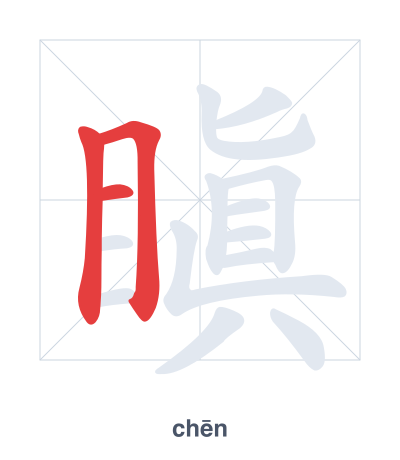
Open Hanzi Writer to see the animated stroke order and practice writing 瞋 with real-time feedback.
The character 瞋 (chēn) is written with 15 strokes. Follow the standard Chinese stroke order: top to bottom, left to right, outside before inside. The radical 目 is one of its key components.
Practice the correct stroke order with the Hanzi Writer app to see animated stroke-by-stroke guidance with real-time feedback.
瞋 means To glare.
The character combines the eye radical 目 with 真 (zhēn, 'true' or 'real'), which serves as a phonetic component. Together, they suggest the act of glaring with intense, focused eyes—‘truly’ opening one’s eyes wide in anger or displeasure.
💡 Memory Tip: Imagine an eye (目) opens so wide that it becomes 'truly' (真) gigantic—that's a terrifying glare.
他瞋目而视。
tā chēn mù ér shì
He stared with angry, wide-open eyes.
请不要瞋怪他。
qǐng bú yào chēn guài tā
Please don't reproach him.
他愤怒地瞋视着。
tā fèn nù dì chēn shì zhe
He glared angrily.
Open Hanzi Writer to see the animated stroke order and practice writing 瞋 with real-time feedback.
✨ Animated stroke order · Handwriting recognition · HSK-graded practice · Free to use
瞋 is composed of the radical 目 (eye) on the left and the phonetic component 真 (zhēn, meaning 'true') on the right. The eye radical shows that the character relates to vision or eye action, while the full character means 'to glare' — staring wide-eyed as if showing one's true angry feelings.