瞈 (wěng) means "To look" in Chinese. It has 15 strokes with the radical 目.
Rated 4.2/5 in difficulty (advanced).
Appears in 3+ common words including 瞈瞈 (wěng wěng), 瞈然 (wěng rán), 瞈视 (wěng shì).
Due to its 15 strokes, Hanzi Writer's error detection shows 瞈 requires focused practice — most learners need 10+ attempts for consistent accuracy.
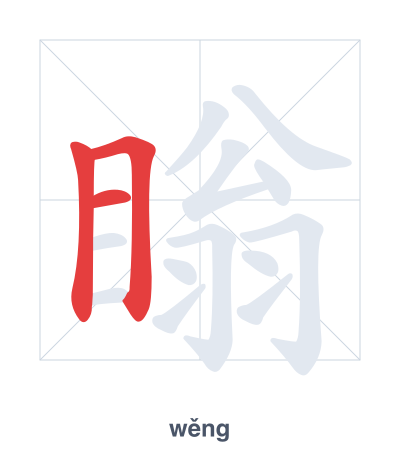
Open Hanzi Writer to see the animated stroke order and practice writing 瞈 with real-time feedback.
The character 瞈 (wěng) is written with 15 strokes. Follow the standard Chinese stroke order: top to bottom, left to right, outside before inside. The radical 目 is one of its key components.
Practice the correct stroke order with the Hanzi Writer app to see animated stroke-by-stroke guidance with real-time feedback.
瞈 means To look.
瞈 is a phono-semantic compound: the radical 目 (eye) indicates the meaning relates to seeing or looking, while 翁 (wēng, meaning 'old man') provides the pronunciation. The character specifically means 'to look' or 'to gaze', though it is quite rare.
💡 Memory Tip: Picture an old man (翁) lifting his eyes (目) to look at something far away, squinting to see clearly.
他的目光瞈瞈。
tā de mù guāng wěng wěng
His gaze was dim and unclear.
瞈然一顾。
wěng rán yī gù
To take a quick glance.
他在瞈视远方。
tā zài wěng shì yuǎn fāng
He is gazing into the distance.
Open Hanzi Writer to see the animated stroke order and practice writing 瞈 with real-time feedback.
✨ Animated stroke order · Handwriting recognition · HSK-graded practice · Free to use
瞈 is made of the radical 目 (eye) on the left and 翁 (wēng, meaning 'old man') on the right. The 目 radical directly indicates that the character relates to seeing or looking, while 翁 provides the pronunciation and adds a sense of focused attention.