领 (lǐng) means "To lead / Neck / Collar" in Chinese. It has 11 strokes with the radical 页, and is HSK Level 3.
Rated 4.2/5 in difficulty (advanced).
Harder than 100% of HSK Level 3 characters.
Appears in 3+ common words including 领导 (lǐng dǎo), 领带 (lǐng dài), 本领 (běn lǐng).
Due to its 11 strokes, Hanzi Writer's error detection shows 领 requires focused practice — most learners need 10+ attempts for consistent accuracy.
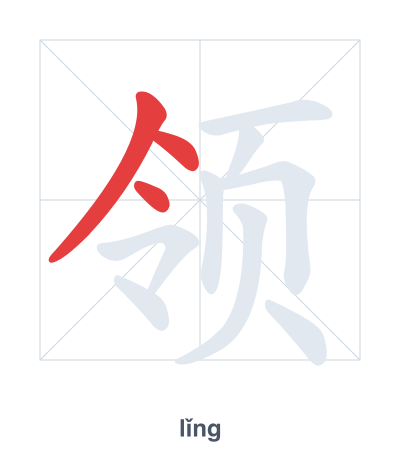
Open Hanzi Writer to see the animated stroke order and practice writing 领 with real-time feedback.
The character 领 (lǐng) is written with 11 strokes. Follow the standard Chinese stroke order: top to bottom, left to right, outside before inside. The radical 页 is one of its key components.
Practice the correct stroke order with the Hanzi Writer app to see animated stroke-by-stroke guidance with real-time feedback.
领 means To lead / Neck / Collar.
As an HSK Level 3 character, 领 is an intermediate-level character.
领 combines the radical 页 (head/neck) with the phonetic 令 (lìng), originally depicting the neck or collar; the sense 'to lead' comes from guiding someone by the neck, like leading an animal or person.
💡 Memory Tip: Picture a leader (令) wearing a distinctive collar (页) that everyone follows.
他是我们的领导。
tā shì wǒ men de lǐng dǎo
He is our leader.
他今天系了红领带。
tā jīn tiān xì le hóng lǐng dài
He wore a red tie today.
他有很多本领。
tā yǒu hěn duō běn lǐng
He has many skills.
Open Hanzi Writer to see the animated stroke order and practice writing 领 with real-time feedback.
✨ Animated stroke order · Handwriting recognition · HSK-graded practice · Free to use
领 is made of 令 (lìng, meaning "order" or "command") on the left and 页 (yè, meaning "head") on the right. Together, they suggest the idea of leading by commanding the head, which connects to meanings like "to lead" and "neck" or "collar" (the part of the body around the head). This structure also helps form words like 领导 (leader) and 领带 (necktie).