险 (xiǎn) means "danger or steep" in Chinese. It has 9 strokes with the radical 阝, and is HSK Level 3.
Rated 3.7/5 in difficulty (challenging).
Harder than 56% of HSK Level 3 characters.
Appears in 3+ common words including 危险 (wēi xiǎn), 保险 (bǎo xiǎn), 冒险 (mào xiǎn).
Due to its 9 strokes, Hanzi Writer's error detection shows 险 requires focused practice — most learners need 10+ attempts for consistent accuracy.
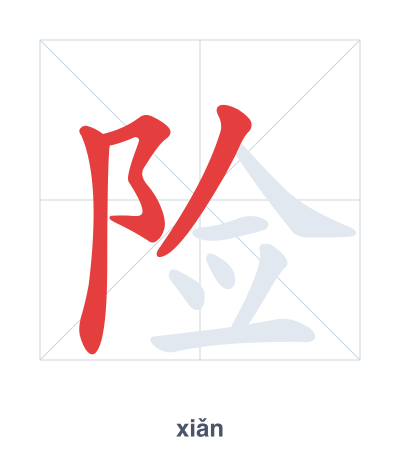
Open Hanzi Writer to see the animated stroke order and practice writing 险 with real-time feedback.
The character 险 (xiǎn) is written with 9 strokes. Follow the standard Chinese stroke order: top to bottom, left to right, outside before inside. The radical 阝 is one of its key components.
Practice the correct stroke order with the Hanzi Writer app to see animated stroke-by-stroke guidance with real-time feedback.
险 means danger or steep.
As an HSK Level 3 character, 险 is an intermediate-level character.
险 is a phono-semantic compound character. The left radical 阝 (representing a mound or hill) indicates the meaning of steep terrain, while the right component 佥 (qiān) provides the pronunciation and originally meant 'all together', reinforcing the idea of a hazardous place where everyone must be cautious. Together, they convey the concept of danger or steepness, as in a treacherous mountain path.
💡 Memory Tip: Picture a steep cliff (阝) where everyone (佥) huddles together, all at risk of falling.
这里很危险。
zhè lǐ hěn wēi xiǎn
It is dangerous here.
我买了人身保险。
wǒ mǎi le rén shēn bǎo xiǎn
I bought life insurance.
他喜欢去森林冒险。
tā xǐ huān qù sēn lín mào xiǎn
He likes adventuring in the forest.
Open Hanzi Writer to see the animated stroke order and practice writing 险 with real-time feedback.
✨ Animated stroke order · Handwriting recognition · HSK-graded practice · Free to use
险 consists of the radical 阝 (meaning a hill or mound) on the left, and 佥 (meaning all or together) on the right, which gives the sound. The left radical suggests a steep hillside, directly connecting to the character's meanings of danger and steepness.