保 (bǎo) means "to protect; to guarantee; to keep" in Chinese. It has 9 strokes with the radical 亻, and is HSK Level 3.
Rated 3.7/5 in difficulty (challenging).
Harder than 46% of HSK Level 3 characters.
Appears in 3+ common words including 保护 (bǎo hù), 保证 (bǎo zhèng), 保险 (bǎo xiǎn).
Due to its 9 strokes, Hanzi Writer's error detection shows 保 requires focused practice — most learners need 10+ attempts for consistent accuracy.
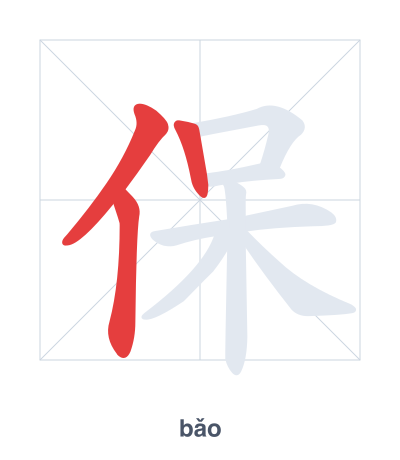
Open Hanzi Writer to see the animated stroke order and practice writing 保 with real-time feedback.
The character 保 (bǎo) is written with 9 strokes. Follow the standard Chinese stroke order: top to bottom, left to right, outside before inside. The radical 亻 is one of its key components.
Practice the correct stroke order with the Hanzi Writer app to see animated stroke-by-stroke guidance with real-time feedback.
保 means to protect; to guarantee; to keep.
As an HSK Level 3 character, 保 is an intermediate-level character.
The character 保 combines the radical 亻 (person) with 呆, which originally depicted a child with outstretched arms. In ancient forms, it showed an adult carrying a child on their back, symbolizing protection and nurture. This visual of a person safeguarding a child gives the meanings 'to protect, guarantee, keep.'
💡 Memory Tip: Imagine a parent (亻) wrapping their arms around a small child (呆) to keep them safe from harm.
我们要保护动物。
wǒ men yào bǎo hù dòng wù
We must protect animals.
我保证完成任务。
wǒ bǎo zhèng wán chéng rèn wù
I guarantee to complete the task.
你买保险了吗?
nǐ mǎi bǎo xiǎn le ma
Have you bought insurance?
Open Hanzi Writer to see the animated stroke order and practice writing 保 with real-time feedback.
✨ Animated stroke order · Handwriting recognition · HSK-graded practice · Free to use
保 is made of the radical 亻 (person) on the left and 呆 (dāi, meaning ‘foolish’ or ‘stay’) on the right. The person radical suggests a human action, while 呆 adds the idea of keeping or staying, together forming the concept of protecting or keeping someone safe.