被 (bèi) means "Quilt; (passive marker)" in Chinese. It has 10 strokes with the radical 衤, and is HSK Level 3.
Rated 4.2/5 in difficulty (advanced).
Harder than 93% of HSK Level 3 characters.
Appears in 3+ common words including 被子 (bèi zi), 被告 (bèi gào), 被动 (bèi dòng).
Due to its 10 strokes, Hanzi Writer's error detection shows 被 requires focused practice — most learners need 10+ attempts for consistent accuracy.
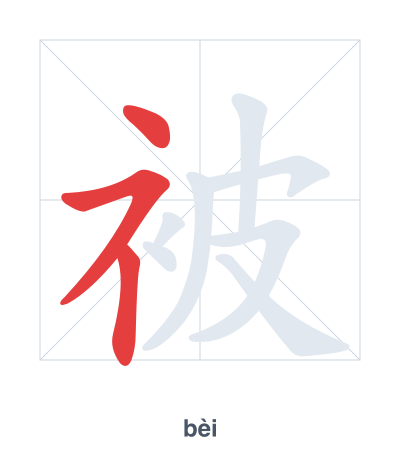
Open Hanzi Writer to see the animated stroke order and practice writing 被 with real-time feedback.
The character 被 (bèi) is written with 10 strokes. Follow the standard Chinese stroke order: top to bottom, left to right, outside before inside. The radical 衤 is one of its key components.
Practice the correct stroke order with the Hanzi Writer app to see animated stroke-by-stroke guidance with real-time feedback.
被 means Quilt; (passive marker).
As an HSK Level 3 character, 被 is an intermediate-level character.
被 combines the clothing radical 衤 (衣) on the left with 皮 (skin/hide) on the right, suggesting a covering or quilt originally made from animal hide. Over time its meaning extended from a physical quilt to a grammatical marker for passive voice, as in 'receiving' an action like being covered by something.
💡 Memory Tip: Picture a quilt (衤) made of animal skin (皮) being thrown over you—you *receive* the covering, just as the passive marker shows you receiving an action.
这床被子很厚实。
zhè chuáng bèi zi hěn hòu shí
This quilt is very thick and substantial.
他是被告。
tā shì bèi gào 。
He is the defendant.
学习不能太被动。
xué xí bù néng tài bèi dòng
Learning should not be too passive.
Open Hanzi Writer to see the animated stroke order and practice writing 被 with real-time feedback.
✨ Animated stroke order · Handwriting recognition · HSK-graded practice · Free to use
The left side is the radical 衤, which means 'clothing,' and the right side is 皮 (pí, skin or leather). Together, the character suggests a covering made of cloth, like a quilt, which is its original meaning.