乐 (lè/yuè) means "music / happy" in Chinese. It has 5 strokes with the radical 丿, and is HSK Level 2.
Rated 2.2/5 in difficulty (moderate).
Harder than 10% of HSK Level 2 characters.
Appears in 4+ common words including 快乐 (kuài lè), 欢乐 (huān lè), 音乐 (yīn yuè).
Hanzi Writer's stroke validation shows learners typically need 5-8 attempts to write 乐 with correct proportion and order.
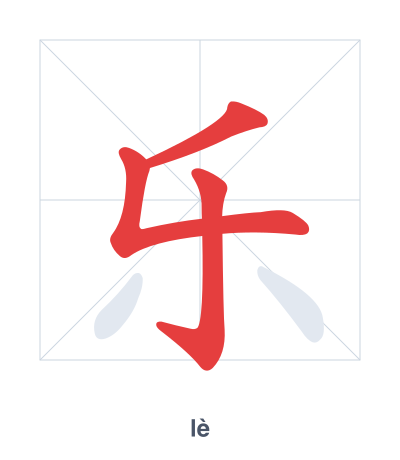
Open Hanzi Writer to see the animated stroke order and practice writing 乐 with real-time feedback.
The character 乐 (lè/yuè) is written with 5 strokes. Follow the standard Chinese stroke order: top to bottom, left to right, outside before inside. The radical 丿 is one of its key components.
Practice the correct stroke order with the Hanzi Writer app to see animated stroke-by-stroke guidance with real-time feedback.
乐 means music / happy.
This is a polyphonic character with readings: lè, yuè.
As an HSK Level 2 character, 乐 is among the first characters beginners learn.
乐 originally depicted a stringed instrument, like a zither, with a wooden frame (similar to 木) and strings. The character's form simplified over time, and its meaning extended from 'music' to 'happiness' because music brings joy.
💡 Memory Tip: Imagine a white (白) stage with two dancers (小) performing joyful music.
祝你在新的一年里生活幸福快乐。
zhù nǐ zài xīn de yī nián lǐ shēng huó xìng fú kuài lè
I wish you a happy and joyful life in the new year.
操场上到处回荡着孩子们的欢乐笑声。
cāo chǎng shàng dào chù huí dàng zhe hái zi men de huān lè xiào shēng
The happy laughter of children echoed everywhere on the playground.
舒缓的音乐能有效缓解精神压力。
shū huǎn de yīn yuè néng yǒu xiào huǎn jiě jīng shén yā lì
Soothing music can effectively relieve mental stress.
他擅长演奏多种民族乐器。
tā shàn cháng yǎn zòu duō zhǒng mín zú yuè qì
He is good at playing various traditional musical instruments.
Open Hanzi Writer to see the animated stroke order and practice writing 乐 with real-time feedback.
✨ Animated stroke order · Handwriting recognition · HSK-graded practice · Free to use
The character 乐 has five strokes. Its top part (丿 and 乛) suggests a curved shape like a musical note or a smiling face, while the bottom part (竖钩, 撇, 点) resembles a small stand or a person raising arms. This structure originally depicted a drum on a stand, linking to the meanings of music and happiness.