噬 (shì) means "to bite or devour" in Chinese. It has 16 strokes with the radical 口.
Rated 4.2/5 in difficulty (advanced).
Appears in 3+ common words including 吞噬 (tūn shì), 噬咬 (shì yǎo), 反噬 (fǎn shì).
Due to its 16 strokes, Hanzi Writer's error detection shows 噬 requires focused practice — most learners need 10+ attempts for consistent accuracy.
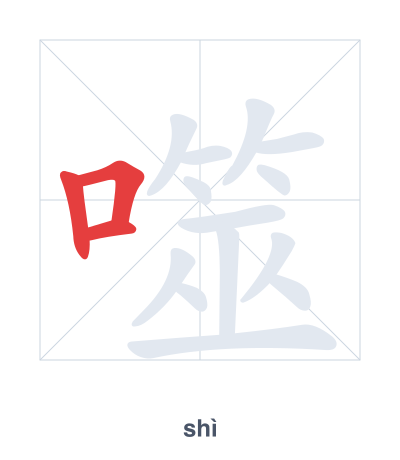
Open Hanzi Writer to see the animated stroke order and practice writing 噬 with real-time feedback.
The character 噬 (shì) is written with 16 strokes. Follow the standard Chinese stroke order: top to bottom, left to right, outside before inside. The radical 口 is one of its key components.
Practice the correct stroke order with the Hanzi Writer app to see animated stroke-by-stroke guidance with real-time feedback.
噬 means to bite or devour.
This character combines the mouth radical (口) with the phonetic component 筮 (shì, 'divination using bamboo stalks'), forming a phono-semantic compound where the mouth indicates the act of biting or devouring. The ancient form of 筮 shows bamboo strips used in divination, but here it solely contributes sound.
💡 Memory Tip: Picture a hungry mouth (口) chomping down on a shaman's divination bamboo (筮) – a fierce, devouring bite.
黑暗吞噬了大地。
hēi àn tūn shì le dà dì
Darkness swallowed the earth.
虫子在噬咬叶子。
chóng zi zài shì yǎo yè zi
The bug is gnawing on the leaf.
这样做会遭到反噬。
zhè yàng zuò huì zāo dào fǎn shì
Doing this will lead to a backlash.
Open Hanzi Writer to see the animated stroke order and practice writing 噬 with real-time feedback.
✨ Animated stroke order · Handwriting recognition · HSK-graded practice · Free to use
噬 has the radical 口 (mouth) on the left, showing the action is done with the mouth. The right part is 筮 (shì), which gives the pronunciation. Together, they create a character that means to bite or devour, linking mouth action to the sound.