嗽 (sòu) means "To cough; to rinse." in Chinese. It has 14 strokes with the radical 口, and is HSK Level 7.
Rated 4.2/5 in difficulty (advanced).
Harder than 49% of HSK Level 7 characters.
Appears in 3+ common words including 咳嗽 (ké sòu), 嗽口 (sòu kǒu), 咳嗽声 (ké sòu shēng).
Due to its 14 strokes, Hanzi Writer's error detection shows 嗽 requires focused practice — most learners need 10+ attempts for consistent accuracy.
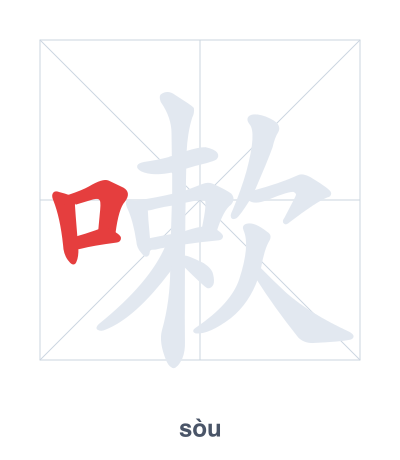
Open Hanzi Writer to see the animated stroke order and practice writing 嗽 with real-time feedback.
The character 嗽 (sòu) is written with 14 strokes. Follow the standard Chinese stroke order: top to bottom, left to right, outside before inside. The radical 口 is one of its key components.
Practice the correct stroke order with the Hanzi Writer app to see animated stroke-by-stroke guidance with real-time feedback.
嗽 means To cough; to rinse..
As an HSK Level 7 character, 嗽 is an intermediate-level character.
嗽 combines the mouth radical (口) with 欶, a component that originally depicted a person coughing or sucking (with 束 'bundle' and 欠 'open mouth' suggesting the action). The character thus directly represents the act of coughing or rinsing the mouth.
💡 Memory Tip: Picture a mouth (口) unleashing a tight bundle (束) of air from an open throat (欠) with a forceful 'sòu' cough.
他感冒了,一直在咳嗽。
tā gǎn mào le yì zhí zài ké sòu
He has a cold and has been coughing.
饭后要记得嗽口。
fàn hòu yào jì de sòu kǒu
Remember to rinse your mouth after meals.
房间里传来咳嗽声。
fáng jiān lǐ chuán lái ké sòu shēng
The sound of coughing came from the room.
Open Hanzi Writer to see the animated stroke order and practice writing 嗽 with real-time feedback.
✨ Animated stroke order · Handwriting recognition · HSK-graded practice · Free to use
嗽 is composed of the radical 口 (mouth) on the left and the component 欶 on the right. 欶 contains 束 (bundle) and 欠 (yawn), which together suggest an action involving the mouth such as coughing or gargling. The mouth radical directly ties both meanings—cough and rinse—to oral actions.