持 (chí) means "to hold; to maintain" in Chinese. It has 9 strokes with the radical 扌, and is HSK Level 3.
Rated 4/5 in difficulty (challenging).
Harder than 62% of HSK Level 3 characters.
Appears in 3+ common words including 支持 (zhī chí), 坚持 (jiān chí), 保持 (bǎo chí).
Due to its 9 strokes, Hanzi Writer's error detection shows 持 requires focused practice — most learners need 10+ attempts for consistent accuracy.
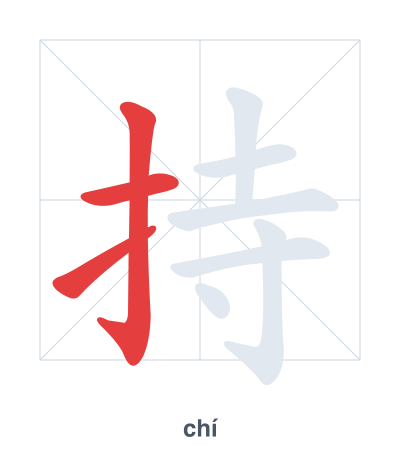
Open Hanzi Writer to see the animated stroke order and practice writing 持 with real-time feedback.
The character 持 (chí) is written with 9 strokes. Follow the standard Chinese stroke order: top to bottom, left to right, outside before inside. The radical 扌 is one of its key components.
Practice the correct stroke order with the Hanzi Writer app to see animated stroke-by-stroke guidance with real-time feedback.
持 means to hold; to maintain.
As an HSK Level 3 character, 持 is an intermediate-level character.
持 combines the hand radical 扌 with 寺, which originally meant 'to hold' in ancient Chinese. Together, a hand holding something conveys the action of grasping or maintaining firm control.
💡 Memory Tip: Picture a hand (扌) gripping a temple (寺) tightly to prevent it from collapsing – that's holding on firmly.
我支持你的决定。
wǒ zhī chí nǐ de jué dìng
I support your decision.
我们要坚持到底。
wǒ men yào jiān chí dào dǐ
We should persevere to the end.
请保持室内安静。
qǐng bǎo chí shì nèi ān jìng
Please keep quiet indoors.
Open Hanzi Writer to see the animated stroke order and practice writing 持 with real-time feedback.
✨ Animated stroke order · Handwriting recognition · HSK-graded practice · Free to use
The left side is the radical 扌, meaning 'hand' or hand actions. The right side is 寺 (sì), which originally meant a temple or official building. Together, they suggest holding something in your hand in a proper, maintained way, leading to meanings like 'to hold' or 'to maintain'.