嗾 (sǒu) means "To egg on; to incite." in Chinese. It has 14 strokes with the radical 口.
Rated 4.2/5 in difficulty (advanced).
Appears in 3+ common words including 嗾使 (sǒu shǐ), 嗾 (sǒu), 谁嗾使 (shuí sǒu shǐ).
Due to its 14 strokes, Hanzi Writer's error detection shows 嗾 requires focused practice — most learners need 10+ attempts for consistent accuracy.
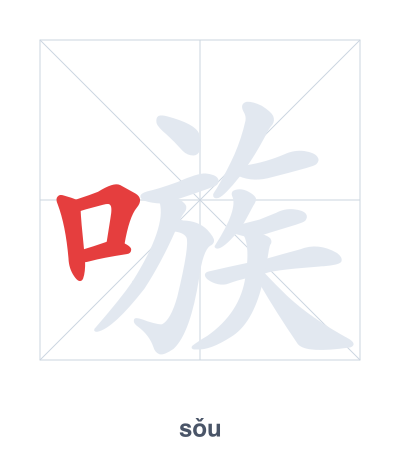
Open Hanzi Writer to see the animated stroke order and practice writing 嗾 with real-time feedback.
The character 嗾 (sǒu) is written with 14 strokes. Follow the standard Chinese stroke order: top to bottom, left to right, outside before inside. The radical 口 is one of its key components.
Practice the correct stroke order with the Hanzi Writer app to see animated stroke-by-stroke guidance with real-time feedback.
嗾 means To egg on; to incite..
This is a phono-semantic compound. The radical 口 (mouth) indicates the action of inciting or urging with speech, while 族 (zú, clan/arrow bundle) provides a phonetic hint for the sound sǒu. The shape of 族 originally depicted a banner (㫃) and arrows (矢), but here it mainly contributes pronunciation.
💡 Memory Tip: Picture a clan leader with a big mouth (口) shouting to incite his entire clan (族) to charge into battle.
他嗾使别人去做坏事。
tā sǒu shǐ bié rén qù zuò huài shì
He instigated others to do bad things.
他嗾的一声唤回了狗。
tā sǒu de yī shēng huàn huí le gǒu
He whistled to call back the dog.
谁嗾使他这么做的?
shuí sǒu shǐ tā zhè me zuò de
Who instigated him to do this?
Open Hanzi Writer to see the animated stroke order and practice writing 嗾 with real-time feedback.
✨ Animated stroke order · Handwriting recognition · HSK-graded practice · Free to use
嗾 is composed of the radical 口 (mouth) on the left and the phonetic component 族 (zú) on the right. The mouth radical hints at the act of using speech to urge or command, while 族 adds the sound and a suggestion of a group being incited.