播 (bō) means "to sow; to broadcast" in Chinese. It has 15 strokes with the radical 扌, and is HSK Level 3.
Rated 4.2/5 in difficulty (advanced).
Harder than 77% of HSK Level 3 characters.
Appears in 3+ common words including 广播 (guǎng bō), 播放 (bō fàng), 播种 (bō zhǒng).
Due to its 15 strokes, Hanzi Writer's error detection shows 播 requires focused practice — most learners need 10+ attempts for consistent accuracy.
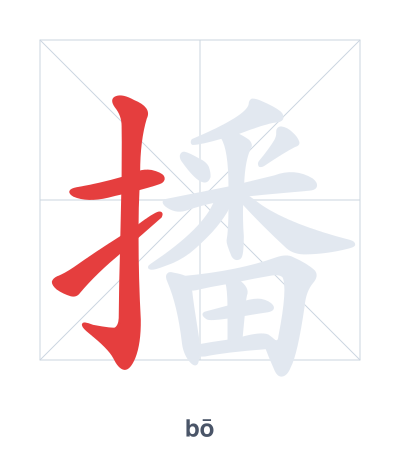
Open Hanzi Writer to see the animated stroke order and practice writing 播 with real-time feedback.
The character 播 (bō) is written with 15 strokes. Follow the standard Chinese stroke order: top to bottom, left to right, outside before inside. The radical 扌 is one of its key components.
Practice the correct stroke order with the Hanzi Writer app to see animated stroke-by-stroke guidance with real-time feedback.
播 means to sow; to broadcast.
As an HSK Level 3 character, 播 is an intermediate-level character.
播 combines the hand radical 扌 (action) with 番 (fān), which originally depicted an animal's footprint or 'turning over.' Together, they show the hand motion of scattering seeds into turned soil—sowing. Later, the meaning extended to 'broadcast' like spreading information.
💡 Memory Tip: Picture a hand (扌) tossing seeds into a field that looks like a plowed grid (番) as you shout 'bō!' to broadcast the seeds everywhere.
广播里在放音乐。
guǎng bō lǐ zài fàng yīn yuè
Music is playing on the radio.
视频正在播放。
shì pín zhèng zài bō fàng
The video is playing.
农民在播种。
nóng mín zài bō zhǒng
Farmers are sowing seeds.
Open Hanzi Writer to see the animated stroke order and practice writing 播 with real-time feedback.
✨ Animated stroke order · Handwriting recognition · HSK-graded practice · Free to use
播 consists of the radical 扌 (hand) on the left, and the phonetic component 番 (fān) on the right. The hand radical suggests an action performed by hand, like sowing seeds, while 番 originally meant "to turn over" or "a turn," linking to the repeated motion of broadcasting or spreading.