证 (zhèng) means "Proof / Certificate / Evidence" in Chinese. It has 7 strokes with the radical 讠, and is HSK Level 3.
Rated 3.2/5 in difficulty (challenging).
Harder than 32% of HSK Level 3 characters.
Appears in 3+ common words including 证明 (zhèng míng), 签证 (qiān zhèng), 证据 (zhèng jù).
Due to its 7 strokes, Hanzi Writer's error detection shows 证 requires focused practice — most learners need 10+ attempts for consistent accuracy.
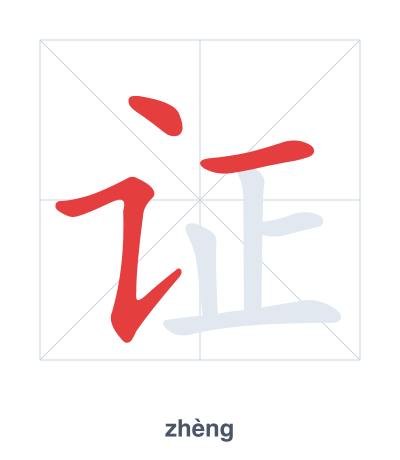
Open Hanzi Writer to see the animated stroke order and practice writing 证 with real-time feedback.
The character 证 (zhèng) is written with 7 strokes. Follow the standard Chinese stroke order: top to bottom, left to right, outside before inside. The radical 讠 is one of its key components.
Practice the correct stroke order with the Hanzi Writer app to see animated stroke-by-stroke guidance with real-time feedback.
证 means Proof / Certificate / Evidence.
As an HSK Level 3 character, 证 is an intermediate-level character.
证 combines the speech radical 讠 (words) with 正 (correct/upright). The original meaning was 'to verify or bear witness,' as in confirming that spoken words are correct or true. Later it extended to mean proof, certificate, or evidence.
💡 Memory Tip: Picture a speech bubble saying "正 (correct)" as undeniable proof of the truth.
请证明你是对的。
qǐng zhèng míng nǐ shì duì de
Please prove that you are right.
我的签证办好了。
wǒ de qiān zhèng bàn hǎo le
My visa is ready.
警察找到了证据。
jǐng chá zhǎo dào le zhèng jù
The police found the evidence.
Open Hanzi Writer to see the animated stroke order and practice writing 证 with real-time feedback.
✨ Animated stroke order · Handwriting recognition · HSK-graded practice · Free to use
The left side 讠 means "speech" or "words," and the right side 正 means "correct" or "upright." Together, they suggest using words to confirm something is correct, which relates to proving or giving evidence. This structure mirrors the character's meanings of proof, certificate, and evidence.