吓 (hè/xià) means "to scare; frighten" in Chinese. It has 6 strokes with the radical 口, and is HSK Level 5.
Rated 3.2/5 in difficulty (challenging).
Harder than 13% of HSK Level 5 characters.
Appears in 4+ common words including 吓人 (xià rén), 惊吓 (jīng xià), 恐吓 (kǒng hè).
Due to its 6 strokes, Hanzi Writer's error detection shows 吓 requires focused practice — most learners need 10+ attempts for consistent accuracy.
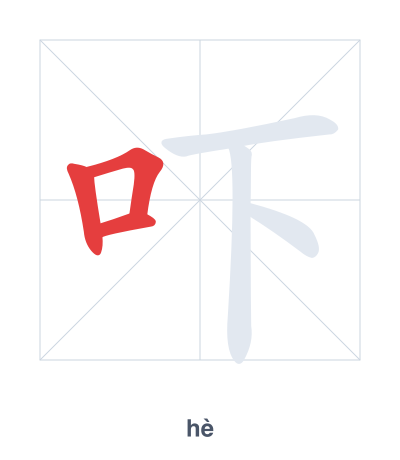
Open Hanzi Writer to see the animated stroke order and practice writing 吓 with real-time feedback.
The character 吓 (hè/xià) is written with 6 strokes. Follow the standard Chinese stroke order: top to bottom, left to right, outside before inside. The radical 口 is one of its key components.
Practice the correct stroke order with the Hanzi Writer app to see animated stroke-by-stroke guidance with real-time feedback.
吓 means to scare; frighten.
This is a polyphonic character with readings: hè, xià.
As an HSK Level 5 character, 吓 is an intermediate-level character.
This simplified compound character combines the mouth radical (口) to indicate a sound or exclamation, and 下 (xià, meaning 'down') which provides a phonetic clue and visually suggests a shout that drives someone down in fear. Originally derived from the complex form 嚇 (with 赫, meaning 'red' or 'to scold'), the simplified version uses 下 while retaining the idea of a frightening sound.
💡 Memory Tip: Picture a huge mouth (口) shouting 'HA!' and the single stroke below (下) shows the terrified person falling flat on the ground.
突然跳出来的黑猫真是一脸吓人。
tū rán tiào chū lái de hēi māo zhēn shì yī liǎn xià rén
The black cat that suddenly jumped out really had a scary look.
这场突如其来的雷雨让小狗受了惊吓。
zhè chǎng tū rú qí lái de léi yǔ ràng xiǎo gǒu shòu le jīng xià
This sudden thunderstorm frightened the puppy.
对方试图通过恐吓来让他放弃诉讼。
duì fāng shì tú tōng guò kǒng hè lái ràng tā fàng qì sù sòng
The other party tried to make him drop the lawsuit through intimidation.
这种卑劣的恫吓手段无法动摇他的决心。
zhè zhǒng bēi liè de dòng hè shǒu duàn wú fǎ dòng yáo tā de jué xīn
These despicable intimidation tactics cannot shake his determination.
Open Hanzi Writer to see the animated stroke order and practice writing 吓 with real-time feedback.
✨ Animated stroke order · Handwriting recognition · HSK-graded practice · Free to use
吓 is made of the mouth radical 口 on the left and 下 (xià, meaning 'down') on the right. The mouth suggests a sound or shout, and combining it with 'down' implies making someone fall or feel low from fear. So the character creates the idea of scaring someone with a loud noise.