惊 (jīng) means "Startled" in Chinese. It has 11 strokes with the radical 忄, and is HSK Level 4.
Rated 4.2/5 in difficulty (advanced).
Harder than 69% of HSK Level 4 characters.
Appears in 3+ common words including 吃惊 (chī jīng), 惊喜 (jīng xǐ), 惊人 (jīng rén).
Due to its 11 strokes, Hanzi Writer's error detection shows 惊 requires focused practice — most learners need 10+ attempts for consistent accuracy.
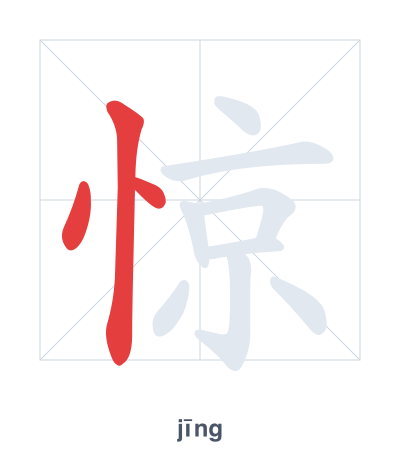
Open Hanzi Writer to see the animated stroke order and practice writing 惊 with real-time feedback.
The character 惊 (jīng) is written with 11 strokes. Follow the standard Chinese stroke order: top to bottom, left to right, outside before inside. The radical 忄 is one of its key components.
Practice the correct stroke order with the Hanzi Writer app to see animated stroke-by-stroke guidance with real-time feedback.
惊 means Startled.
As an HSK Level 4 character, 惊 is an intermediate-level character.
惊 is a phono-semantic compound: the left side 忄 (heart) conveys emotion, and the right side 京 (jīng, capital city) gives the sound. The character depicts the heart reacting with sudden shock, as if a surprising event in the capital startles everyone.
💡 Memory Tip: Picture your heart (忄) leaping up to the top of a tall capital building (京) in sudden fright.
听到这个消息我很吃惊。
tīng dào zhè ge xiāo xī wǒ hěn chī jīng
I was very surprised to hear this news.
这是一个大惊喜。
zhè shì yí gè dà jīng xǐ
This is a big surprise.
他的进步非常惊人。
tā de jìn bù fēi cháng jīng rén
His progress is very amazing.
Open Hanzi Writer to see the animated stroke order and practice writing 惊 with real-time feedback.
✨ Animated stroke order · Handwriting recognition · HSK-graded practice · Free to use
惊 combines the radical 忄 (heart) on the left with 京 (jīng, capital) on the right. The heart radical indicates a feeling or emotion, while 京 provides a phonetic hint for pronunciation. Together, they convey a sudden emotion—being startled—as if the heart jumps when surprised.