恫 (dòng) means "to threaten" in Chinese. It has 9 strokes with the radical 忄.
Rated 4/5 in difficulty (challenging).
Appears in 3+ common words including 恫吓 (dòng hè), 哀恫 (āi dòng), 恫疑 (dòng yí).
Due to its 9 strokes, Hanzi Writer's error detection shows 恫 requires focused practice — most learners need 10+ attempts for consistent accuracy.
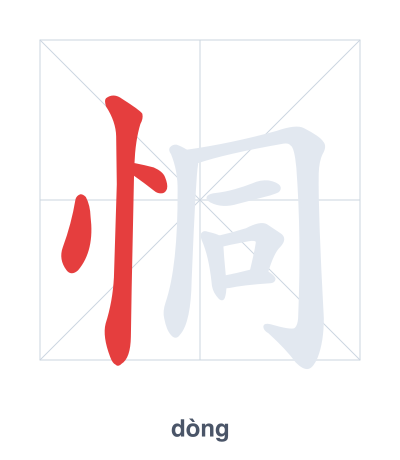
Open Hanzi Writer to see the animated stroke order and practice writing 恫 with real-time feedback.
The character 恫 (dòng) is written with 9 strokes. Follow the standard Chinese stroke order: top to bottom, left to right, outside before inside. The radical 忄 is one of its key components.
Practice the correct stroke order with the Hanzi Writer app to see animated stroke-by-stroke guidance with real-time feedback.
恫 means to threaten.
The character 恫 combines the heart radical 忄, indicating emotion, with the phonetic component 同 (tóng, 'same'). Its original meaning was 'pain' or 'sorrow' in the heart, which later extended to 'to threaten', as threats inflict fear and emotional pain.
💡 Memory Tip: Picture a heart (忄) trembling as a menacing figure points and says, 'You'll get the same (同) treatment if you don't comply!'
他试图恫吓对手。
tā shì tú dòng hè duì shǒu
He tried to intimidate the opponent.
他的离去令人哀恫。
tā de lí qù lìng rén āi dòng
His departure is deeply sorrowful.
这种说法令人恫疑。
zhè zhǒng shuō fǎ lìng rén dòng yí
This statement causes fear and suspicion.
Open Hanzi Writer to see the animated stroke order and practice writing 恫 with real-time feedback.
✨ Animated stroke order · Handwriting recognition · HSK-graded practice · Free to use
恫 is composed of the radical 忄 (heart) on the left and 同 (tóng, same) on the right. The heart radical indicates emotions or feelings, so 恫 relates to emotional states like fear or grief. The right side 同 provides a phonetic hint but also suggests a shared or collective feeling, as in threatening someone together.