恐 (kǒng) means "Fear; to fear; perhaps" in Chinese. It has 10 strokes with the radical 心, and is HSK Level 3.
Rated 4.2/5 in difficulty (advanced).
Harder than 76% of HSK Level 3 characters.
Appears in 3+ common words including 恐怕 (kǒng pà), 恐怖 (kǒng bù), 恐惧 (kǒng jù).
Due to its 10 strokes, Hanzi Writer's error detection shows 恐 requires focused practice — most learners need 10+ attempts for consistent accuracy.
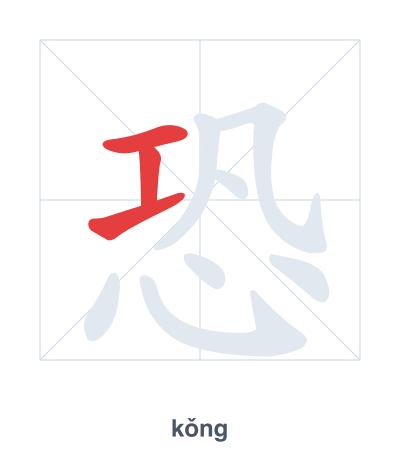
Open Hanzi Writer to see the animated stroke order and practice writing 恐 with real-time feedback.
The character 恐 (kǒng) is written with 10 strokes. Follow the standard Chinese stroke order: top to bottom, left to right, outside before inside. The radical 心 is one of its key components.
Practice the correct stroke order with the Hanzi Writer app to see animated stroke-by-stroke guidance with real-time feedback.
恐 means Fear; to fear; perhaps.
As an HSK Level 3 character, 恐 is an intermediate-level character.
The character 恐 combines the heart radical 心 with the phonetic component 巩 (gǒng, meaning 'to consolidate'), depicting a heart that is tightened or constricted by fear. The top part 巩 itself comprises 工 (work) and 凡 (all), suggesting the overwhelming pressure that leads to terror.
💡 Memory Tip: Picture a heart (心) being squeezed by a heavy workbench (工) and a swirling wind (凡) — that tight, panicked feeling is 恐 (fear).
恐怕明天会下雨。
kǒng pà míng tiān huì xià yǔ
I'm afraid it will rain tomorrow.
这个电影很恐怖。
zhè ge diàn yǐng hěn kǒng bù
This movie is very scary.
他心里充满恐惧。
tā xīn lǐ chōng mǎn kǒng jù
His heart was full of fear.
Open Hanzi Writer to see the animated stroke order and practice writing 恐 with real-time feedback.
✨ Animated stroke order · Handwriting recognition · HSK-graded practice · Free to use
恐 is formed with 巩 (gǒng) on top and the heart radical 心 (xīn) below. The heart radical shows that fear is an emotion, while 巩 provides the sound. Together, they create the meaning of fear or dread.