糕 (gāo) means "Cake" in Chinese. It has 16 strokes with the radical 米, and is HSK Level 5.
Rated 4.2/5 in difficulty (advanced).
Harder than 87% of HSK Level 5 characters.
Appears in 3+ common words including 蛋糕 (dàn gāo), 糕点 (gāo diǎn), 年糕 (nián gāo).
Due to its 16 strokes, Hanzi Writer's error detection shows 糕 requires focused practice — most learners need 10+ attempts for consistent accuracy.
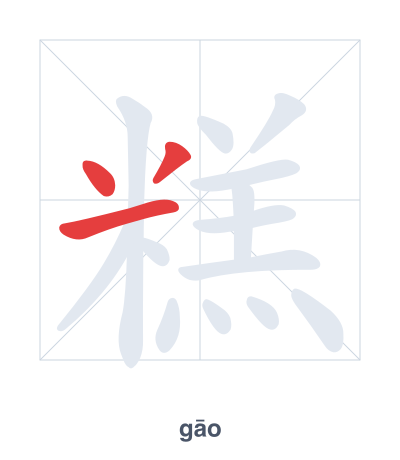
Open Hanzi Writer to see the animated stroke order and practice writing 糕 with real-time feedback.
The character 糕 (gāo) is written with 16 strokes. Follow the standard Chinese stroke order: top to bottom, left to right, outside before inside. The radical 米 is one of its key components.
Practice the correct stroke order with the Hanzi Writer app to see animated stroke-by-stroke guidance with real-time feedback.
糕 means Cake.
As an HSK Level 5 character, 糕 is an intermediate-level character.
糕 combines the radical 米 (rice, indicating the main ingredient) with 羔 (lamb, providing the pronunciation gāo). Rice cakes are often steamed, and lamb was traditionally prepared by steaming, so the character visually links a rice-based steamed cake with the sound and cooking method of lamb.
💡 Memory Tip: Picture a cake made of rice flour (米) shaped like a fluffy little lamb (羔) sitting on a plate.
生日要吃蛋糕。
shēng rì yào chī dàn gāo
One should eat cake on their birthday.
这里的糕点很出名。
zhè lǐ de gāo diǎn hěn chū míng
The pastries here are very famous.
过年要吃年糕。
guò nián yào chī nián gāo
We eat rice cakes during the New Year.
Open Hanzi Writer to see the animated stroke order and practice writing 糕 with real-time feedback.
✨ Animated stroke order · Handwriting recognition · HSK-graded practice · Free to use
The left side is 米, meaning 'rice' or 'grain,' which indicates that 糕 is a food made from grain. The right side is 羔, which gives the character its pronunciation gāo but does not directly relate to the meaning of cake.