籽 (zǐ) means "Seed" in Chinese. It has 9 strokes with the radical 米.
Rated 4/5 in difficulty (challenging).
Appears in 3+ common words including 瓜籽 (guā zǐ), 菜籽 (cài zǐ), 籽粒 (zǐ lì).
Due to its 9 strokes, Hanzi Writer's error detection shows 籽 requires focused practice — most learners need 10+ attempts for consistent accuracy.
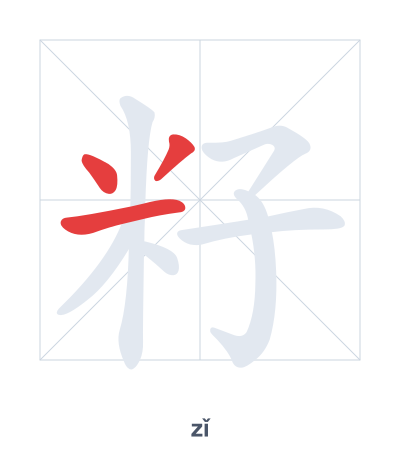
Open Hanzi Writer to see the animated stroke order and practice writing 籽 with real-time feedback.
The character 籽 (zǐ) is written with 9 strokes. Follow the standard Chinese stroke order: top to bottom, left to right, outside before inside. The radical 米 is one of its key components.
Practice the correct stroke order with the Hanzi Writer app to see animated stroke-by-stroke guidance with real-time feedback.
籽 means Seed.
籽 combines the radical 米 (rice/grain) with 子 (child). Since seeds are like the 'children' of plants, and grains themselves originate from seeds, the character visually represents a grain giving birth to a new plant.
💡 Memory Tip: Imagine a tiny 'child' (子) tucked inside a grain of rice (米) — that's the seed waiting to grow.
我们一边聊天一边吃瓜籽。
wǒ men yī biān liáo tiān yī biān chī guā zǐ
We chat while eating melon seeds.
菜籽可以用来榨油。
cài zǐ kě yǐ yòng lái zhà yóu
Rapeseeds can be used to extract oil.
这些玉米籽粒非常饱满。
zhè xiē yù mǐ zǐ lì fēi cháng bǎo mǎn
These corn kernels are very plump.
Open Hanzi Writer to see the animated stroke order and practice writing 籽 with real-time feedback.
✨ Animated stroke order · Handwriting recognition · HSK-graded practice · Free to use
籽 combines the radical 米 (rice) on the left with 子 (child) on the right. Since seeds often come from rice or grain plants, 米 shows the plant category, and 子 suggests a small offspring, together meaning 'seed'.