粗 (cū) means "Thick; coarse; rough; crude" in Chinese. It has 11 strokes with the radical 米, and is HSK Level 4.
Rated 4.2/5 in difficulty (advanced).
Harder than 84% of HSK Level 4 characters.
Appears in 3+ common words including 粗心 (cū xīn), 粗糙 (cū cāo), 粗粮 (cū liáng).
Due to its 11 strokes, Hanzi Writer's error detection shows 粗 requires focused practice — most learners need 10+ attempts for consistent accuracy.
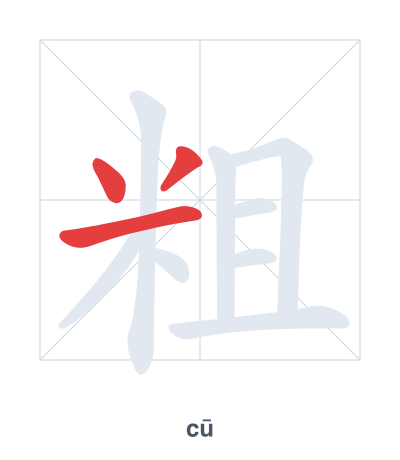
Open Hanzi Writer to see the animated stroke order and practice writing 粗 with real-time feedback.
The character 粗 (cū) is written with 11 strokes. Follow the standard Chinese stroke order: top to bottom, left to right, outside before inside. The radical 米 is one of its key components.
Practice the correct stroke order with the Hanzi Writer app to see animated stroke-by-stroke guidance with real-time feedback.
粗 means Thick; coarse; rough; crude.
As an HSK Level 4 character, 粗 is an intermediate-level character.
粗 combines the radical 米 (rice) with the component 且, which originally indicated 'coarse' or 'unrefined'—together they depict unpolished, thick grains of rice, symbolizing coarseness and roughness.
💡 Memory Tip: Picture a giant, thick grain of rice (米) that is so rough it looks like a jagged rock (shaped like 且).
他在考试时非常粗心。
tā zài kǎo shì shí fēi cháng cū xīn
He was very careless during the exam.
这块木头的表面很粗糙。
zhè kuài mù tou de biǎo miàn hěn cū cāo
The surface of this wood is very rough.
多吃粗粮对身体有好处。
duō chī cū liáng duì shēn tǐ yǒu hǎo chù
Eating more whole grains is good for your health.
Open Hanzi Writer to see the animated stroke order and practice writing 粗 with real-time feedback.
✨ Animated stroke order · Handwriting recognition · HSK-graded practice · Free to use
粗 is made of the radical 米 (rice) on the left and the phonetic component 且 (qiě) on the right. Rice grains are naturally small and refined, so 米 combined with 且 suggests something that is not refined — hence meanings like "coarse" or "rough." The structure hints at unprocessed, thick grain materials.