粽 (zòng) means "Zongzi (sticky rice dumpling)." in Chinese. It has 14 strokes with the radical 米, and is HSK Level 7.
Rated 4.2/5 in difficulty (advanced).
Harder than 79% of HSK Level 7 characters.
Appears in 3+ common words including 粽子 (zòng zi), 肉粽 (ròu zòng), 包粽子 (bāo zòng zi).
Due to its 14 strokes, Hanzi Writer's error detection shows 粽 requires focused practice — most learners need 10+ attempts for consistent accuracy.
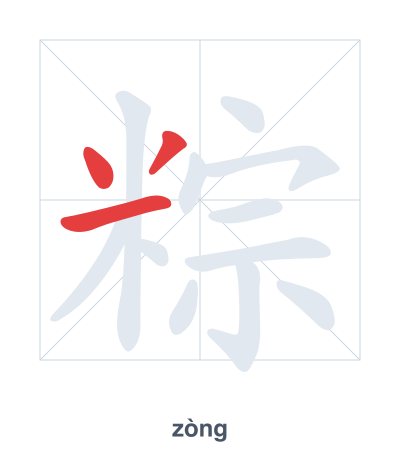
Open Hanzi Writer to see the animated stroke order and practice writing 粽 with real-time feedback.
The character 粽 (zòng) is written with 14 strokes. Follow the standard Chinese stroke order: top to bottom, left to right, outside before inside. The radical 米 is one of its key components.
Practice the correct stroke order with the Hanzi Writer app to see animated stroke-by-stroke guidance with real-time feedback.
粽 means Zongzi (sticky rice dumpling)..
As an HSK Level 7 character, 粽 is an intermediate-level character.
The character 粽 combines the radical 米 (rice) with the phonetic component 宗 (zōng, meaning 'ancestor'), reflecting that zongzi is a rice dish traditionally made to honor ancestors during the Dragon Boat Festival.
💡 Memory Tip: Picture a sticky rice dumpling (米) sitting on an ancestral altar (宗) as an offering during the festival.
端午节要吃粽子。
duān wǔ jié yào chī zòng zi
One should eat zongzi during the Dragon Boat Festival.
我喜欢吃肉粽。
wǒ xǐ huān chī ròu zòng
I like eating meat zongzi.
奶奶在包粽子。
nǎi nǎi zài bāo zòng zi
Grandma is making sticky rice dumplings (zongzi).
Open Hanzi Writer to see the animated stroke order and practice writing 粽 with real-time feedback.
✨ Animated stroke order · Handwriting recognition · HSK-graded practice · Free to use
粽 is composed of the radical 米 (rice) on the left and the phonetic component 宗 (zōng) on the right. The rice radical indicates that this character refers to a rice-based food, which is the sticky rice used in zongzi. 宗 provides the sound 'zong', making 粽 a sound-meaning compound.