粜 (tiào) means "to sell grain" in Chinese. It has 11 strokes with the radical 米.
Rated 4.2/5 in difficulty (advanced).
Appears in 3+ common words including 粜米 (tiào mǐ), 粜谷 (tiào gǔ), 粜粮 (tiào liáng).
Due to its 11 strokes, Hanzi Writer's error detection shows 粜 requires focused practice — most learners need 10+ attempts for consistent accuracy.
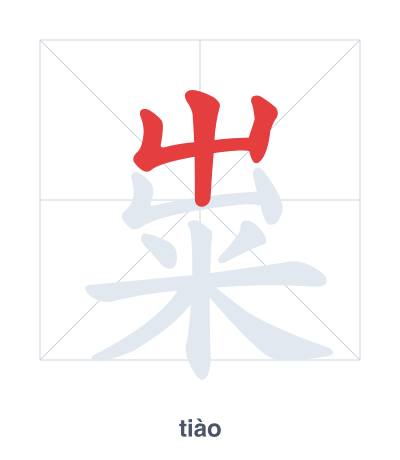
Open Hanzi Writer to see the animated stroke order and practice writing 粜 with real-time feedback.
The character 粜 (tiào) is written with 11 strokes. Follow the standard Chinese stroke order: top to bottom, left to right, outside before inside. The radical 米 is one of its key components.
Practice the correct stroke order with the Hanzi Writer app to see animated stroke-by-stroke guidance with real-time feedback.
粜 means to sell grain.
粜 is a compound character combining 出 (to go out) above 米 (rice/grain), visually depicting grain being sent out. This directly represents the meaning of selling or exporting grain, as the product leaves the seller's hands.
💡 Memory Tip: Picture a sack of rice (米) being pushed out the door (出) to sell at the market.
农民去集市上粜米。
nóng mín qù jí shì shàng tiào mǐ
The farmer went to the market to sell rice.
今年粜谷的价格比较高。
jīn nián tiào gǔ de jià gé bǐ jiào gāo
The price for selling grain is relatively high this year.
他把家里多余的粮粜了。
tā bǎ jiā lǐ duō yú de liáng tiào le
He sold the surplus grain from his home.
Open Hanzi Writer to see the animated stroke order and practice writing 粜 with real-time feedback.
✨ Animated stroke order · Handwriting recognition · HSK-graded practice · Free to use
粜 is composed of 出 (chū, meaning "to go out") on top and 米 (mǐ, meaning "rice") below. This structure literally means "rice going out," which represents the action of selling grain.